
TrojanDownloader:HTML/Adodb.gen!A: what it is and how to remove it
TrojanDownloader:HTML/Adodb.gen!A is a detection name that you can encounter at any time when your computer is running. This type of malware can be encountered as a script that affects the way browsers operate.
Facts checked October 6, 2026. Removal steps tested on Windows 11 (26H2) and checked against Microsoft's and the browser makers' current documentation. Sections marked as our earlier report are the original text: they describe the threat as it was then and have not been reviewed since. The 2026 status, the removal steps and the questions are current.
Automatic
Get a free scan and check if your PC is infected.
Fortect finds malware, unwanted programs and the Windows damage they leave behind, and repairs it in one pass.
An automatic scan can look at TrojanDownloader.VBS and the other programs installed around the same time.
Do it yourself · free Remove TrojanDownloader:HTML/Adodb.gen!A yourself 6 steps, about 18 minutes, no software needed.
Start the steps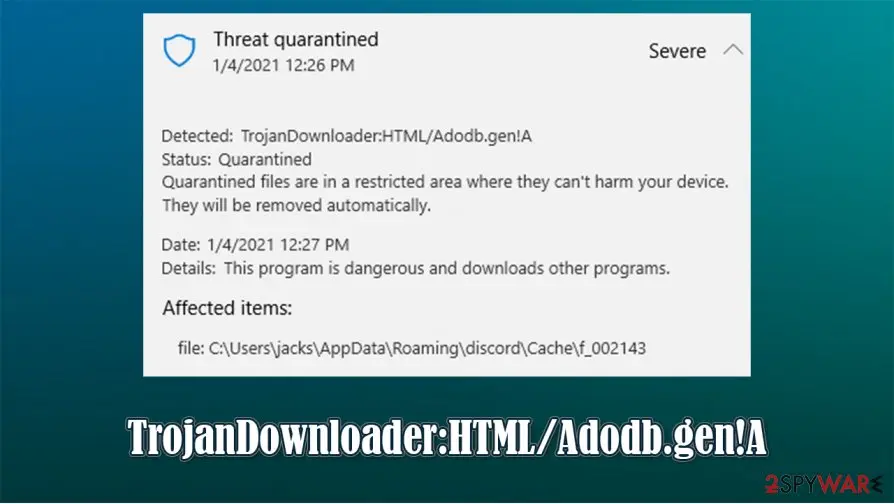
TrojanDownloader:HTML/Adodb.gen!A: summary
| Distribution | This particular malware was found being distributed via communication platform Discord |
|---|---|
| Name | TrojanDownloader:HTML/Adodb.gen!A |
| Type | Malware |
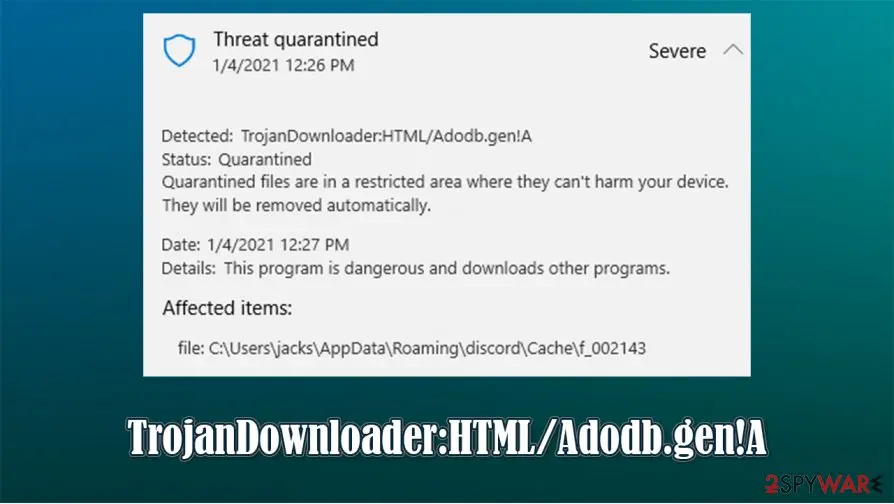
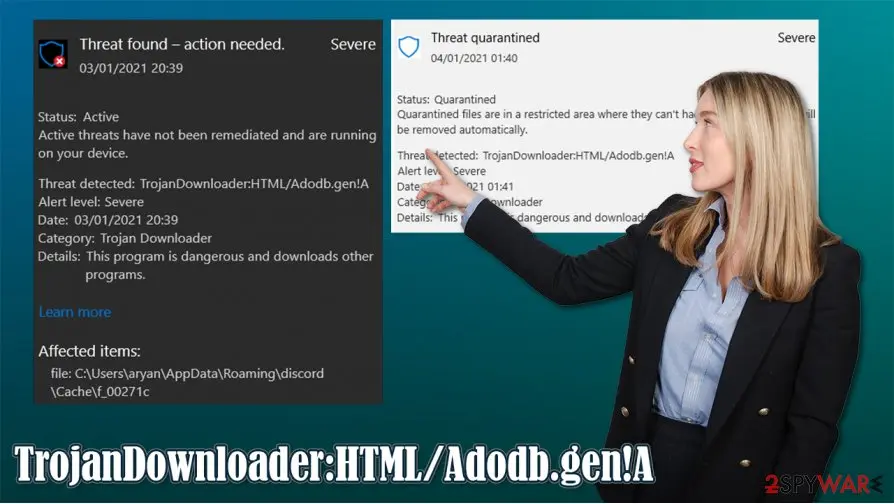
| Threat location | C:\Users\AppData\Roaming\discord\Cache\ |
| Symptoms | Detection from security software is the only symptom you might experience |
| Capabilities | By using the malicious script, malware authors could escalate their privileges and execute malicious code on the host device |
| Removal | Scan the PC with security software to find and remove the malware and anything installed with it. Fortect scans Windows for malware and repairs the system files and settings it damaged. Remove it nowTo use the full-featured product, you have to purchase a license for Fortect. The scan is free. |
Show 8 more facts
| Related | TrojanDownloader.VBS.Agent, Trojan.Downloader, TrojanDownloader:PowerShell/Falsip.A |
|---|---|
| Detection names | No Microsoft detection name is known |
| Damage | Not recorded in the old report |
| Evidence | One write-up by a security site; no sample analysed yet |
| File names | TrojanDownloader.VBS and C:\Users\AppData\Roaming\discord\Cache\ |
| First seen | 14 January 2021 |
| Microsoft Defender name | TrojanDownloader:HTML/Adodb.gen!A |
| Facts checked | 6 October 2026 |
What TrojanDownloader:HTML/Adodb.gen!A does on an infected PC
From our report of Jan 2021 · not reviewed since
TrojanDownloader:HTML/Adodb.gen!A - malware that typically resides in Discord cache folder
TrojanDownloader:HTML/Adodb.gen!A is a detection name that you can encounter at any time when your computer is running.
This type of malware can be encountered as a script that affects the way browsers operate. Many users have complained about Windows Defender or another security software flagging this malware on their computers, and the detected file was located in the following location:
Allegedly, the detection is related to a Discord picture file that has been sent around the web. Users who downloaded suspicious files said they received a pop-up message from their security tools. Since TrojanDownloader:HTML/Adodb.gen!A is a generic detection name, it might be a false-positive, but you should always investigate before making decisions.
TrojanDownloader:HTML/Adodb.gen!A is generally an HTML script - a piece of code that can be executed when certain conditions are met. It means that this code might run on the targeted system without the installation of malicious software. This can be particularly dangerous, as security software might fail to detect such behavior.
HTML is a programming language that is often used within a browser environment, and pieces of code can be found on every visited website. However, it can also be used for malicious purposes and, once executed, might be exploited by cybercriminals. Other similar scripts that can be used for malware are:
By using this Trojan, threat actors would be able to execute malicious code on the targeted machine. Consequently, they could initiate actions that benefit them,
Users can encounter the TrojanDownloader:HTML/Adodb.gen!A virus after downloading a picture sent via Discord communication app. This software is extremely prevalent, with millions of users worldwide - it is especially popular within the gaming community.
However, malware authors can often abuse the platform for malicious intent to spread Discord viruses around. In fact, this is not the first time that the app was used to deliver malicious files or links that would allow scamming users in various ways. Previously, threat actors were distributing Spidey Bot to steal users' personal information.
When talking of this particular Trojan capabilities, it could allow the attackers to do the same. It could also result in the infiltration of other malware, such as backdoors or ransomware. The latter is particularly dangerous, as it could result in a complete data loss. This is why a timely TrojanDownloader:HTML/Adodb.gen!A removal is so important.
Since the malware is running based on HTML script, it is likely to affect various browsers, including Google Chrome, Mozilla Firefox, Safari, MS Edge, etc. For example, it could be employed by threat actors to steal all the information typed into them. As a result, users could suffer from serious privacy issues or even experience and identity theft.
Luckily, it is unlikely that this malware can actually cause any harm, at least not when security software flags it. Thus, if you saw this threat is detected on your device, you should not ignore it and remove TrojanDownloader:HTML/Adodb.gen!A by sending it to quarantine immediately and deleting all the related files.
If you have any doubts and have reason to believe that the detection is a false positive, you can always perform an additional scan with alternative security software, such as or . To fix virus damage, if such has occurred, we highly recommend using .
- VBS (Visual Basic)
- JavaScript.
From our report of Jan 2021 · not reviewed since
More from our earlier report on TrojanDownloader:HTML/Adodb.gen!A
- In case the file is flagged once again - eliminate it immediately
- Malware infections can diminish the performance of your computer or cause serious stability issues.
How TrojanDownloader:HTML/Adodb.gen!A got on your PC
From our report of Jan 2021 · not reviewed since
Communication platforms are extremely popular nowadays, as people use them to send private messages, videos, music, and another type of multimedia.
Discord is one of the most popular VoIP platforms currently and is especially beloved by gaming and a few other communities. Unfortunately, the prevalence of such apps is constantly being abused by malicious actors, as they use these platforms to deliver malware and scam users into disclosing their personal information.
Therefore, it is always important to know that the communication platforms can be, and will be, used to deliver malicious programs or scripts. To avoid such situations, you should always be aware that a direct message (DM) from an unknown individual should never be trusted. It is important not to click on links that could redirect to spoofing or boobytrapped websites.
In case there is no security software installed, malware could be executed immediately. In some cases, avoiding links might not always be possible, hence you need to employ additional precautions:
- keep an up-to-date security tool running at all times
- patch all the software on your machine with the latest updates.
How to check the PC for TrojanDownloader:HTML/Adodb.gen!A
Which name will your scanner show?
Microsoft's name for TrojanDownloader:HTML/Adodb.gen!A is TrojanDownloader:HTML/Adodb.gen!A.
Defender sorts threats by category first, so the word before the colon tells you what kind of program was found, even if the family name means nothing to you.
Do not search for a removal tool by the detection name alone; fake "removal tools" use the same keywords. How the naming works is explained in our guide to antivirus detection names.
- Path:
C:\Users\AppData\Roaming\discord\Cache\ - File:
TrojanDownloader.VBS
How to remove TrojanDownloader:HTML/Adodb.gen!A
A loader's job is to install other malware, so treat the PC as infected with more than one program until the scans are clean.
Step 1: Check where TrojanDownloader.VBS runs from and stop it
TrojanDownloader.VBSis the part you can see, and its location tells you whether it belongs there. Right-click it on the Processes page of Task Manager and choose Open file location, then right-click the file > Properties > Digital Signatures to see who signed it.An unsigned file, or one in a user folder such as
%AppData%, is the one to remove: end the task, then delete the file.Note the folder name, because the same folder usually holds its other files. This is the same in Windows 11 and Windows 10.
Full procedure with screenshots: Close a frozen app (Task Manager, Force Quit) On uGetFix
Step 2: Delete scheduled tasks that bring it back
Open Task Scheduler from the Start menu and click Task Scheduler Library. Select each task you do not recognise and read the Actions tab:
- a task that starts a file in
%AppData%or%Temp% - runs
powershellwith a long encoded line - opens a web address belongs to TrojanDownloader:HTML/Adodb.gen!A or a similar program
Right-click such a task and choose Delete, and check the subfolders too. Leave tasks from Microsoft, your PC's maker and programs you use. Task Scheduler is the same in Windows 11 and Windows 10.
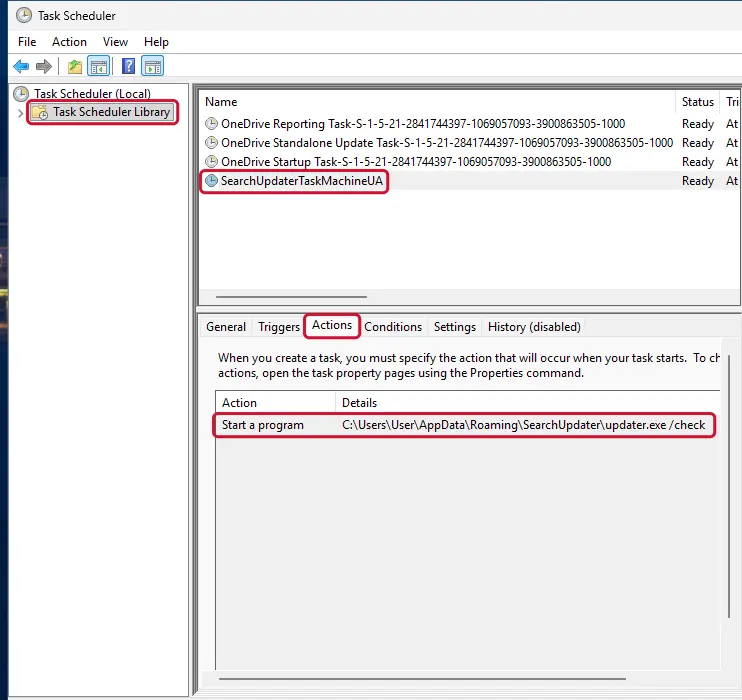
Windows 11: Task Scheduler Library, the task selected, the Actions tab shows the file it runs. Full procedure with screenshots: Remove what malware leaves behind in Windows
- a task that starts a file in
Step 3: Remove it from startup
Whatever TrojanDownloader:HTML/Adodb.gen!A installed usually starts with Windows. Open Task Manager with Ctrl + Shift + Esc, go to Startup apps in Windows 11 or the Startup tab in Windows 10, and disable what you do not know, starting with entries that have an empty Publisher column.
Open file location on the right-click menu shows the file, which helps you decide and tells you what to delete later. Disabling is safe: if something you need stops working, switch it back on.
Full procedure with screenshots: Stop apps from opening at startup On uGetFix
Step 4: Delete the folders left behind
What the uninstaller leaves behind is usually in the user folders. Open File Explorer, switch on View > Show > Hidden items (in Windows 10 View > Hidden items), and go through
%LocalAppData%,%AppData%, %ProgramData% and the two Program Files folders.Sort by Date modified and delete folders that appeared together with the problem and belong to no program you use. Folders with random names that hold
.exe,.dll, .js or .ps1 files are the strongest sign.Full procedure with screenshots: Remove what malware leaves behind in Windows
Step 5: Scan the PC, then run the offline scan
Open Windows Security > Virus & threat protection > Scan options, run a Full scan and remove everything it finds. Then select Microsoft Defender Antivirus (offline scan) and click Scan now: the PC restarts and scans before Windows loads, which finds files that hide while Windows runs.
Save your work first, because the offline scan takes about 15 minutes. Both scans are built into Windows 11 and Windows 10, and a second scanner from another vendor is a useful extra opinion.
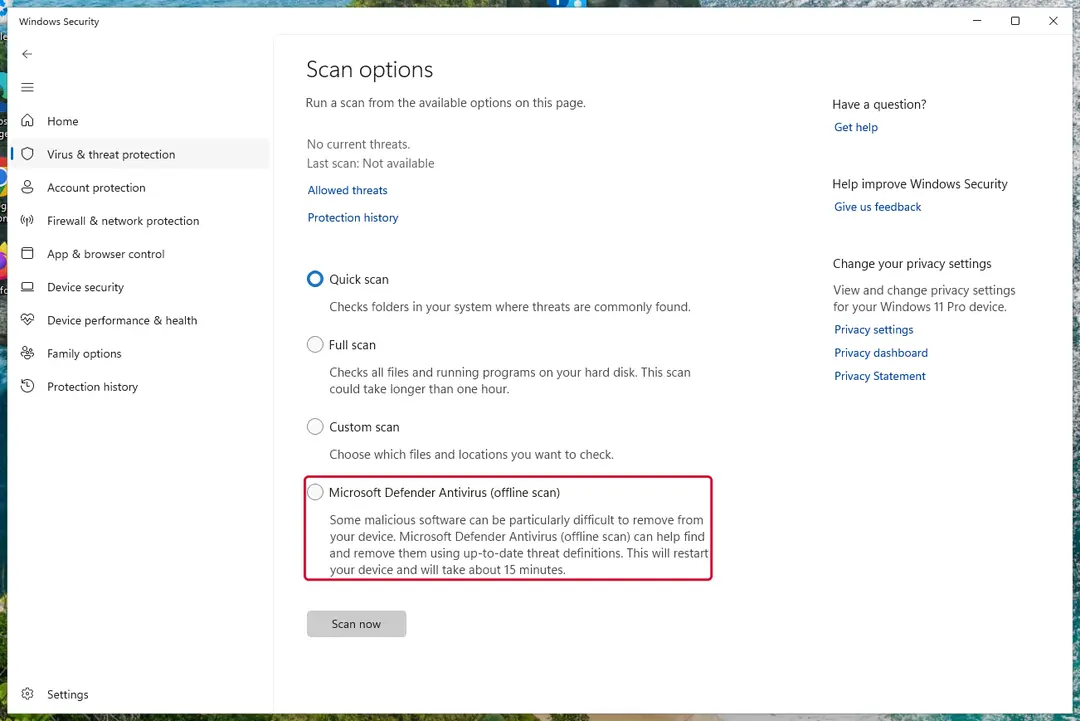
Windows 11: Windows Security > Virus & threat protection > Scan options. Full procedure with screenshots: Run a Microsoft Defender Offline scan
Step 6: Change passwords from another device and sign out other sessions
Assume that the passwords saved in this PC's browsers, and the accounts that were open in them, are known to the attacker. From a phone or a clean computer, change the e-mail password first, then banking, shopping, social and gaming accounts.
Use each service's option to sign out of all other sessions, because stolen cookies keep a session open even after a password change. Turn on two-step verification on each account. Wait with the infected Windows 11 or Windows 10 PC until the scans are clean.
Full procedure with screenshots: Turn on two-step verification / secure a hacked account
Instructions for each browser and system
The detailed steps for every browser and system this guide covers. Open the one you use.
Remove from Google Chrome
Delete malicious extensions from Google Chrome:
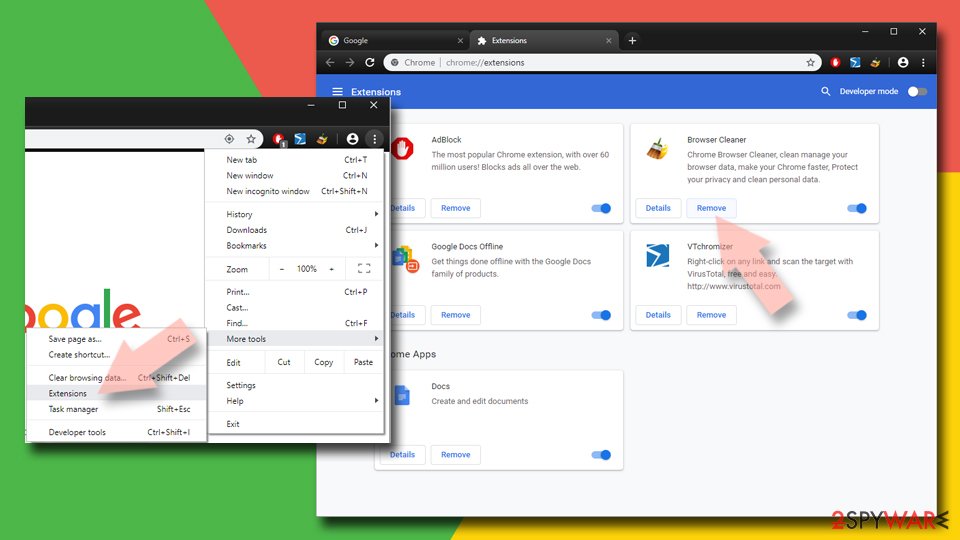
- Open Google Chrome, click on the Menu (three vertical dots at the top-right corner) and select More tools > Extensions.
- In the newly opened window, you will see all the installed extensions. Uninstall all suspicious extensions related to the unwanted program by clicking Remove.
Clear cache and web data from Chrome:
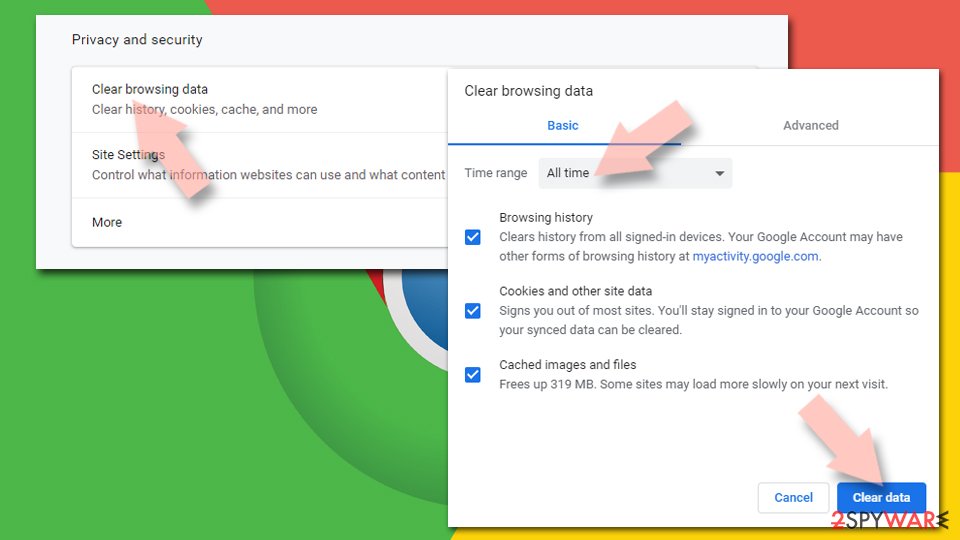
- Click on Menu and pick Settings.
- Under Privacy and security, select Clear browsing data.
- Select Browsing history, Cookies and other site data, as well as Cached images and files.
- Click Clear data.
Change your homepage:
- Click menu and choose Settings.
- Look for a suspicious site in the On startup section.
- Click on Open a specific or set of pages and click on three dots to find the Remove option.
Reset Google Chrome:
If the previous methods did not help you, reset Google Chrome to eliminate all the unwanted components:
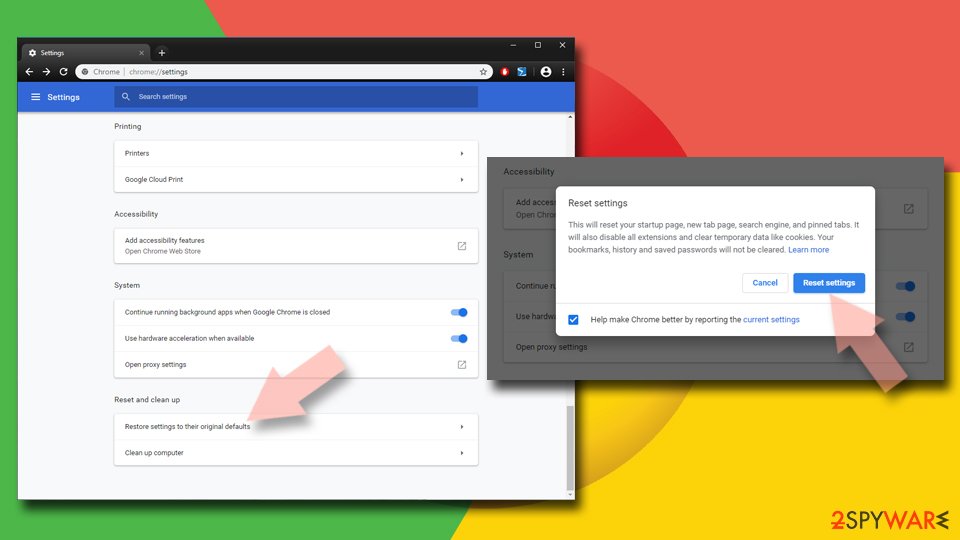
- Click on Menu and select Settings.
- In the Settings, scroll down and click Advanced.
- Scroll down and locate Reset and clean up section.
- Now click Restore settings to their original defaults.
- Confirm with Reset settings.
Remove from Microsoft Edge
Delete unwanted extensions from MS Edge:
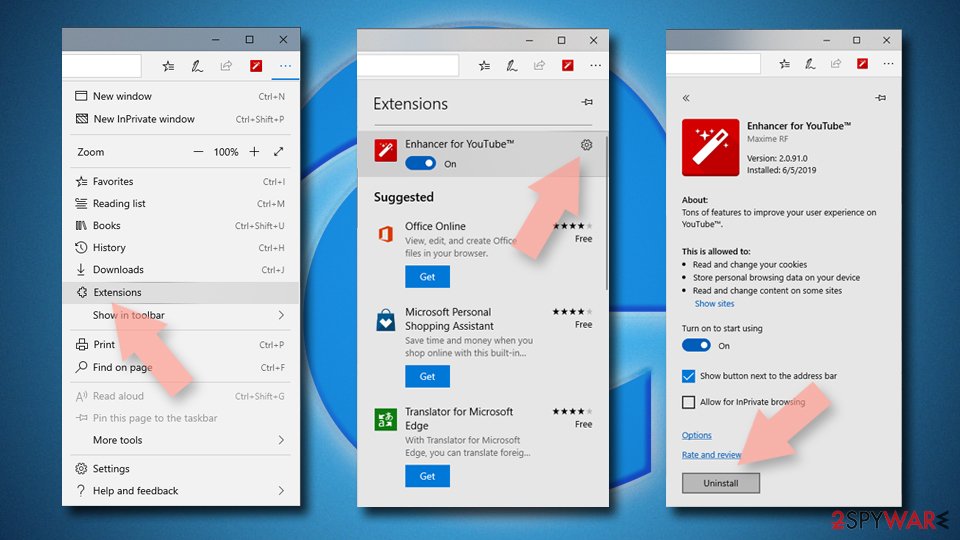
- Select Menu (three horizontal dots at the top-right of the browser window) and pick Extensions.
- From the list, pick the extension and click on the Gear icon.
- Click Remove.
Clear cookies and other browser data:
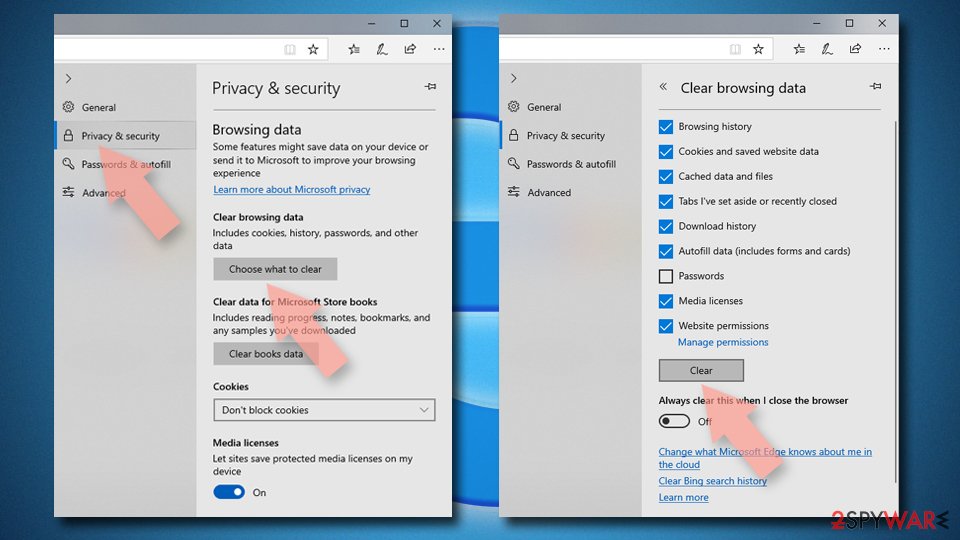
- Click on the Menu (three horizontal dots at the top-right of the browser window) and select Settings > Privacy, search, and services..
- Under Clear browsing data, pick Choose what to clear.
- Select Cookies and other site data and Cached images and files. (apart from passwords, although you might want to include Media licenses as well, if applicable) and click on Clear.
Restore new tab and homepage settings:
- Click the menu icon and choose Settings.
- Then find On startup section.
- Click Remove next to any suspicious startup page.
Reset MS Edge if the above steps did not work:
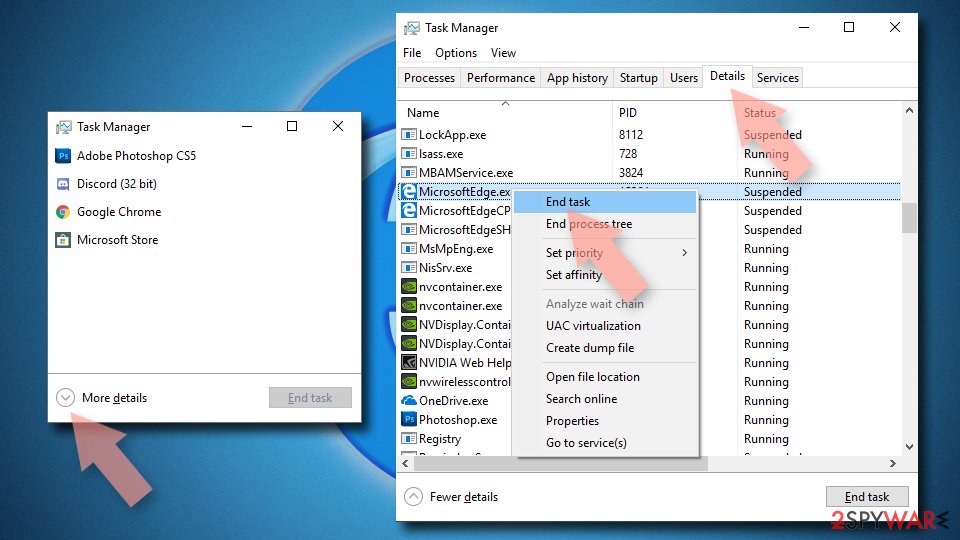
- Press on Ctrl + Shift + Esc to open Task Manager.
- Click on More details arrow at the bottom of the window.
- Select Details tab.
- Now scroll down and locate every entry with Microsoft Edge name in it. Right-click on each of them and select End Task to stop MS Edge from running.
Delete extensions from MS Edge (Chromium):
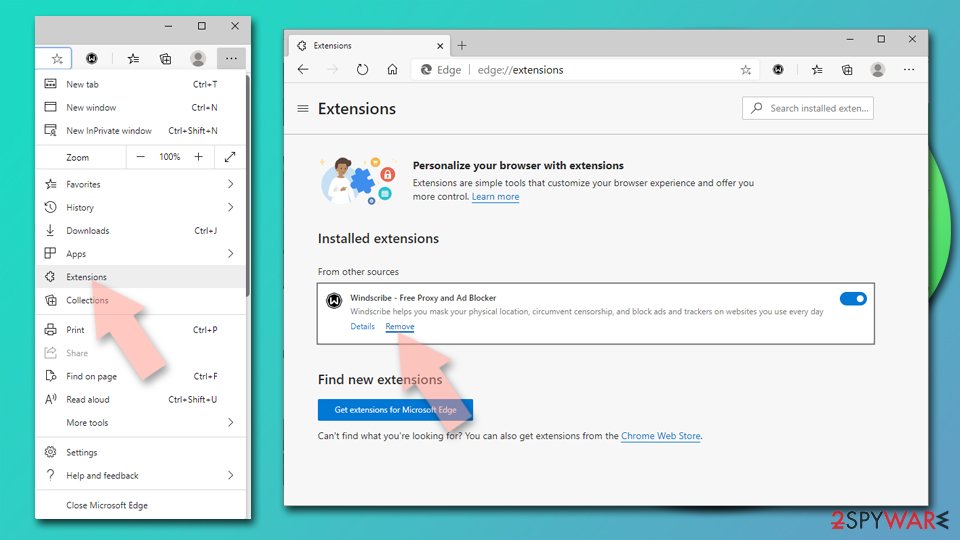
- Open Edge and click select Settings > Extensions.
- Delete unwanted extensions by clicking Remove.
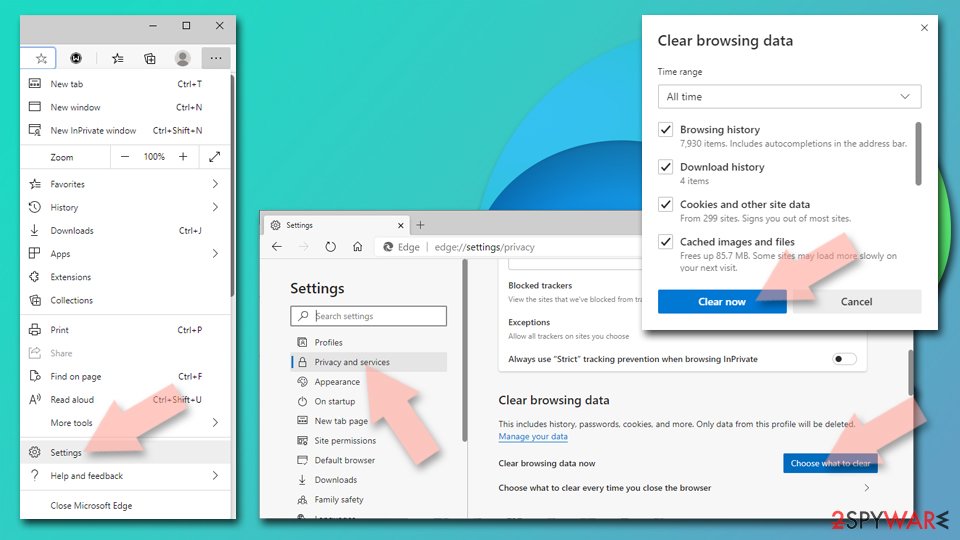
Clear cache and site data:
- Click on Menu and go to Settings.
- Select Privacy, search and services.
- Under Clear browsing data, pick Choose what to clear.
- Under Time range, pick All time.
- Select Clear now.
Reset Chromium-based MS Edge:
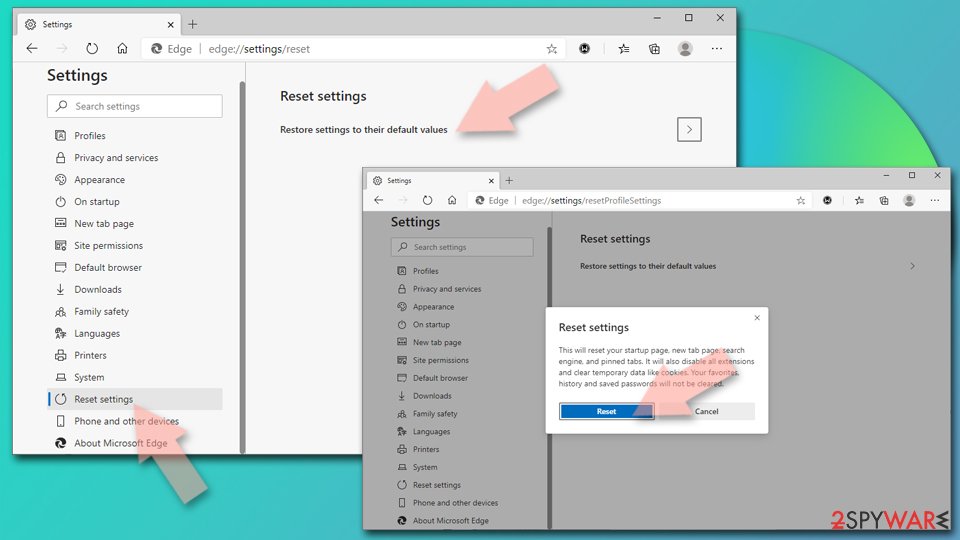
- Click on Menu and select Settings.
- On the left side, pick Reset settings.
- Select Restore settings to their default values.
- Confirm with Reset.
- This will disable extensions and reset startup pages but will not delete bookmarks, saved passwords, or browsing history.
Remove from Mozilla Firefox (FF)
Clean Mozilla Firefox after you delete all malware from your device:
Remove dangerous extensions:
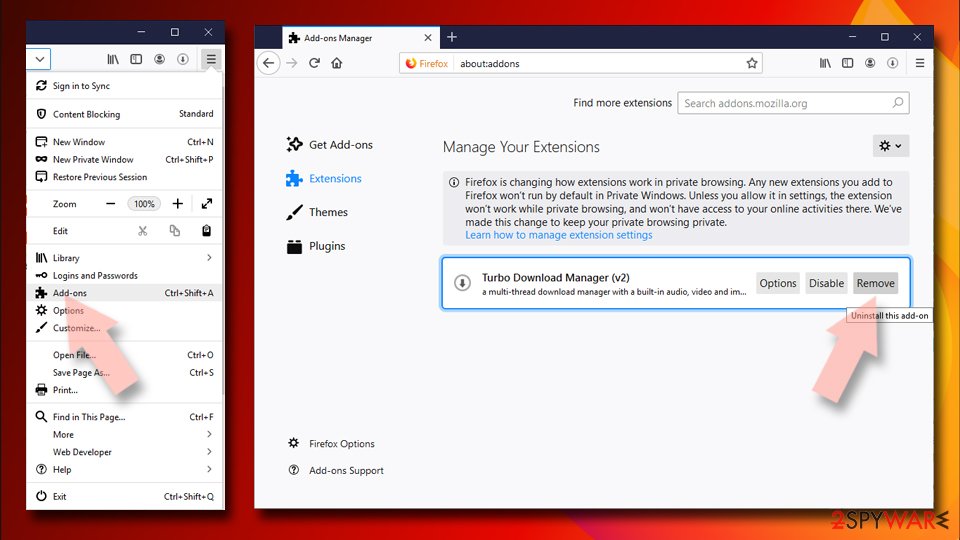
- Open Mozilla Firefox browser and click on the Menu (three horizontal lines at the top-right of the window).
- Select Add-ons.
- In here, select the unwanted extension and click Remove.
Reset the homepage:
- Click three horizontal lines at the top right corner to open the menu.
- Choose Settings.
- Under Home, set your preferred homepage and new tab settings.
Clear cookies and site data:
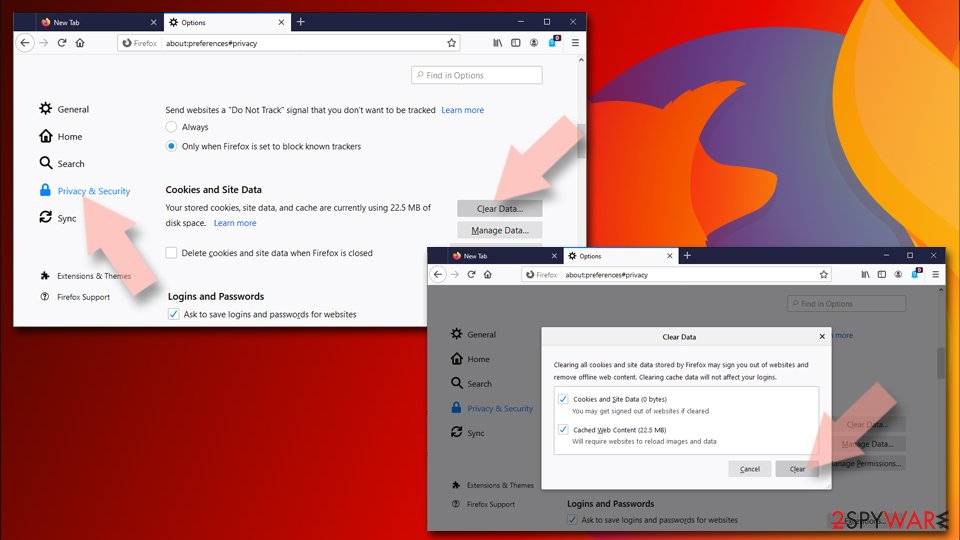
- Click Menu and pick Settings.
- Go to Privacy & Security section.
- Scroll down to locate Cookies and Site Data.
- Click on Clear Data...
- Select Cookies and Site Data and Temporary cached files and pages, then click Clear.
Reset Mozilla Firefox
If clearing the browser as explained above did not help, reset Mozilla Firefox:
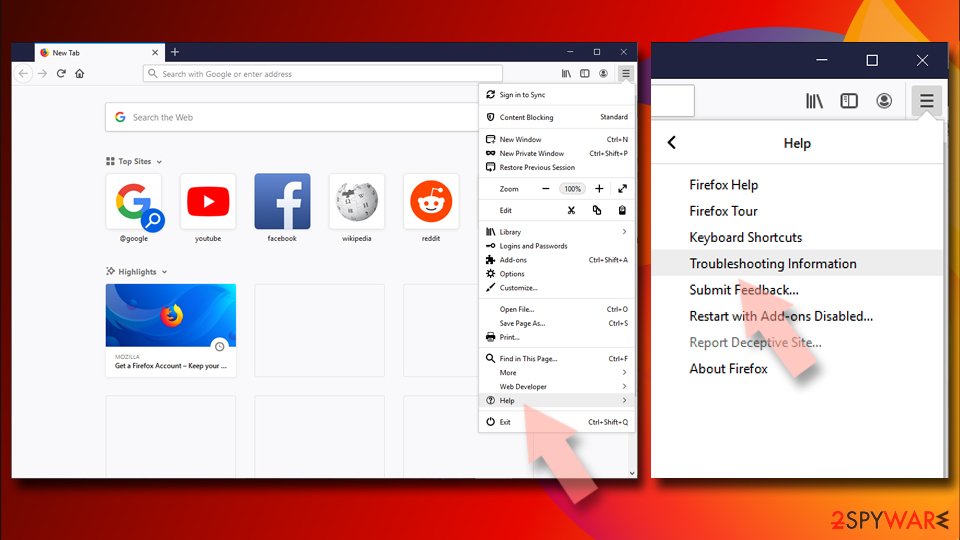
- Open Mozilla Firefox browser and click the Menu.
- Go to Help and then choose Troubleshooting Information.
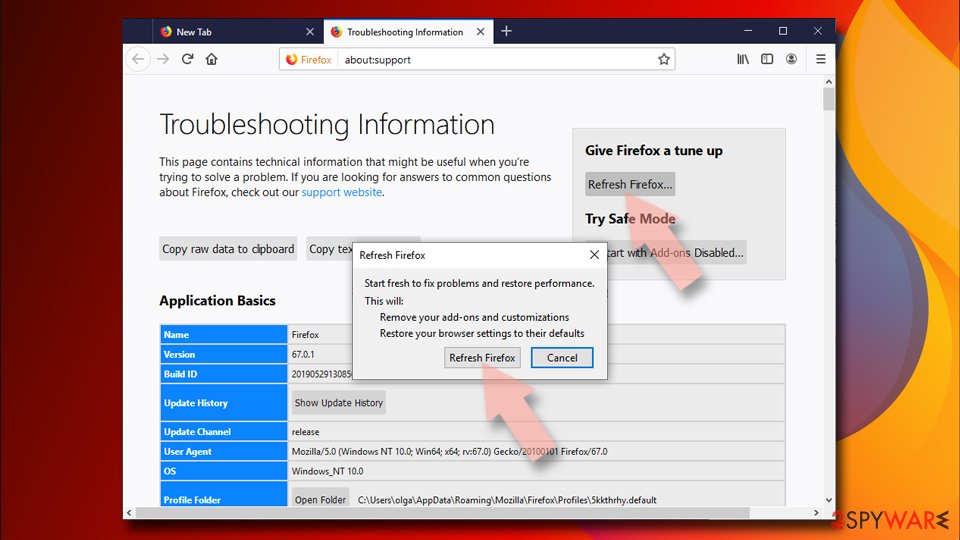
- Under Give Firefox a tune up section, click on Refresh Firefox...
- Once the pop-up shows up, confirm the action by pressing on Refresh Firefox.
Delete from Safari
Remove dangerous extensions:
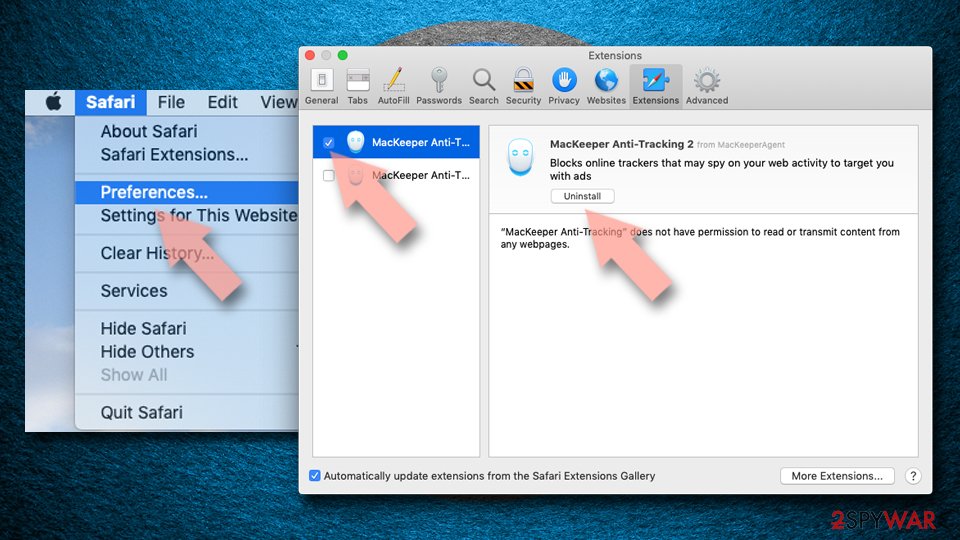
- Open Safari, click Safari in the menu at the top-left of the screen, and select Preferences.
- Go to the Extensions tab, look for any suspicious entries, and click Uninstall to remove them.
Clear history and website data:
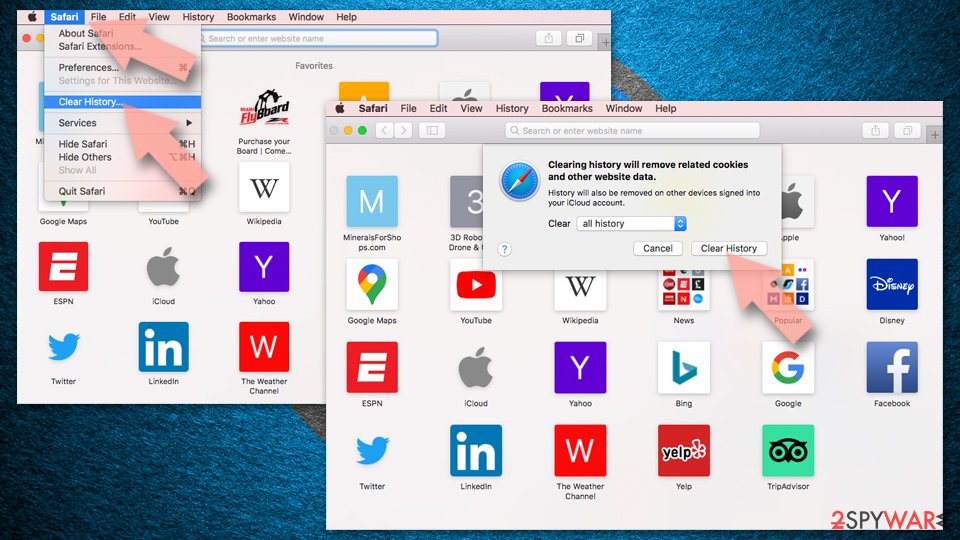
- Click Safari in the menu and pick Clear History.
- Set Clear to all history and confirm with Clear History.
Reset Safari:
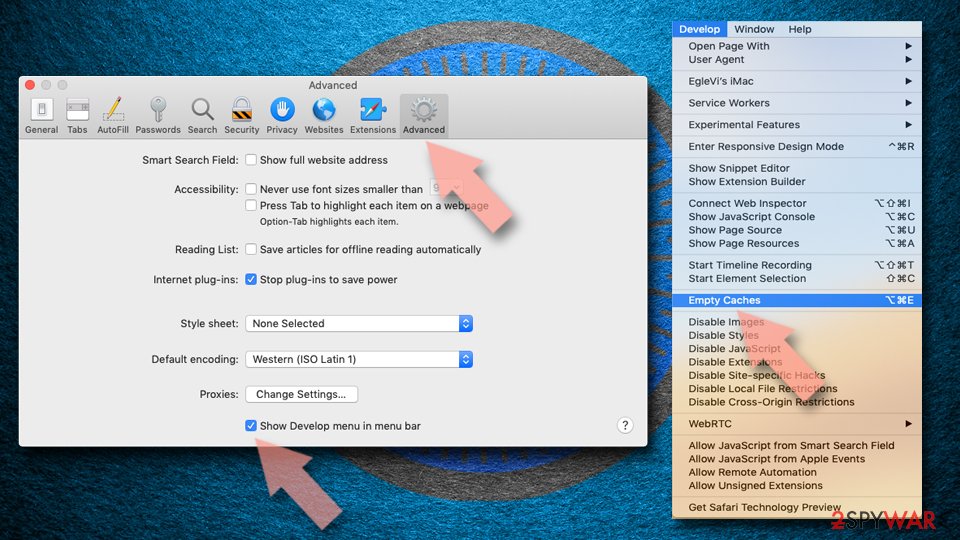
- Click Safari in the menu and select Preferences > Advanced.
- Enable Show Develop menu in menu bar.
- From the menu bar, click Develop and select Empty Caches.
Reset Internet Explorer
Remove dangerous add-ons:
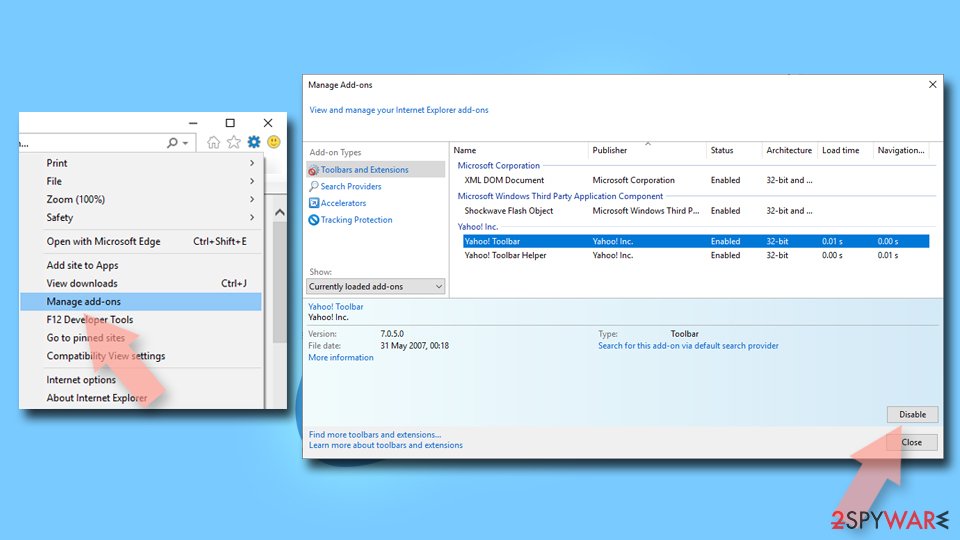
- Open Internet Explorer, click on the Gear icon (IE menu) on the top-right corner of the browser
- Pick Manage Add-ons.
- You will see a Manage Add-ons window. Here, look for suspicious plugins. Click on these entries and select Disable.
Change your homepage if it was altered:
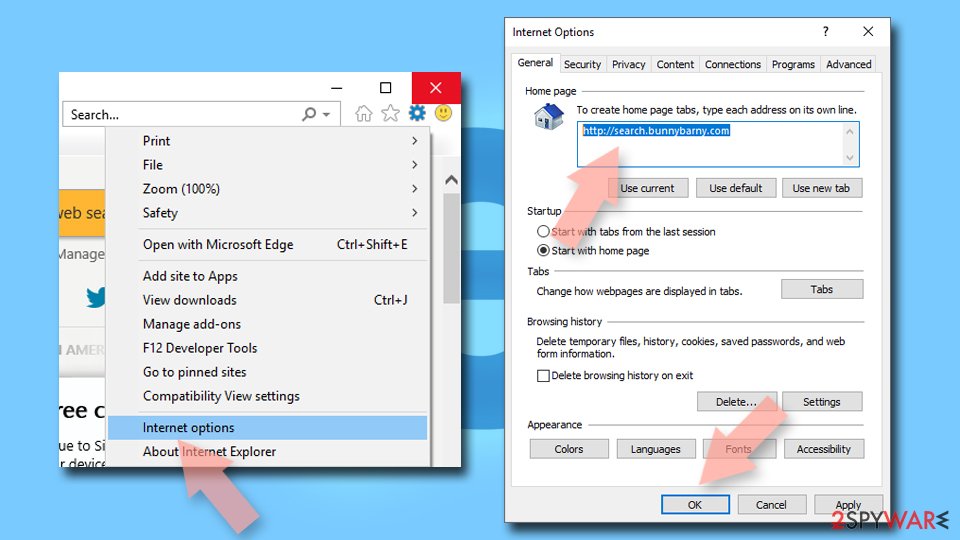
- Open IE and click on the Gear icon.
- Select Internet Options.
- In the General tab, delete the Home page address and replace it by your preferred one (for example, Google.com).
- Click Apply and then select OK.
Delete temporary files:
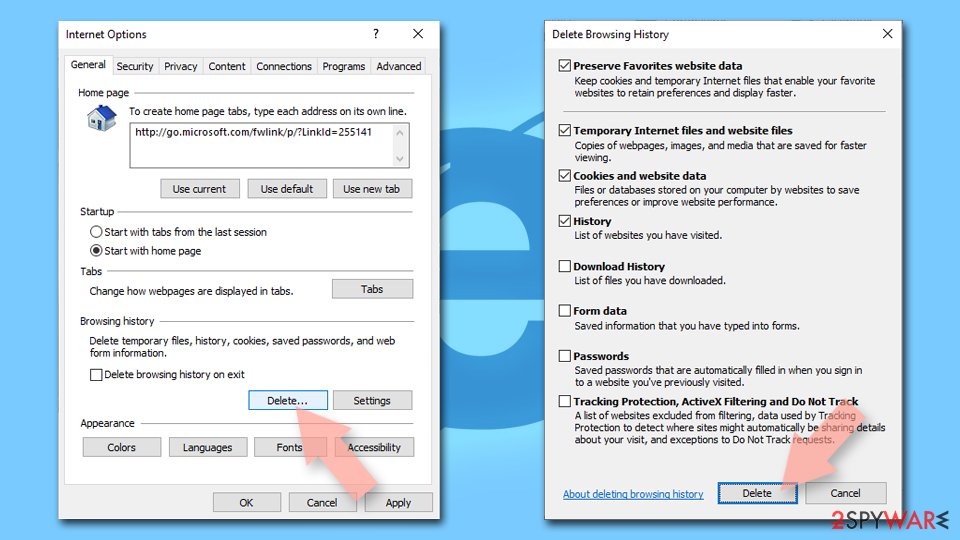
- Press on the Gear icon and select Internet Options.
- Under Browsing history, click Delete...
- Select relevant fields and press Delete.
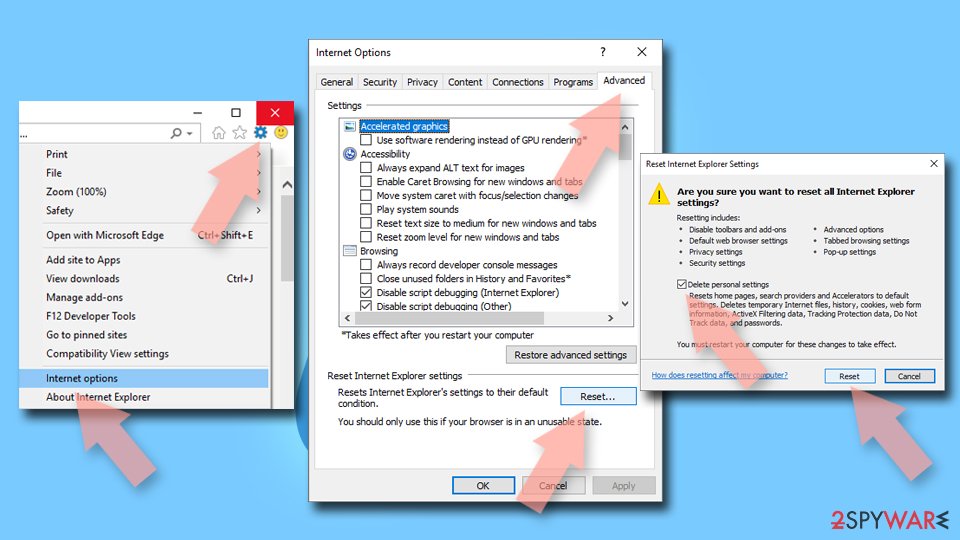
Reset Internet Explorer:
- Click on Gear icon > Internet options and select Advanced tab.
- Select Reset.
- In the new window, check Delete personal settings and select Reset.
Manual removal using Safe Mode
Important! →
Manual removal guide might be too complicated for regular computer users. It requires advanced IT knowledge to be performed correctly (if vital system files are removed or damaged, it might result in full Windows compromise), and it also might take hours to complete. Therefore, we highly advise using the automatic method provided above instead.
Step 1. Access Safe Mode with Networking
Manual malware removal should be best performed in the Safe Mode environment.
Windows 7 / Vista / XP
- Click Start > Shutdown > Restart > OK.
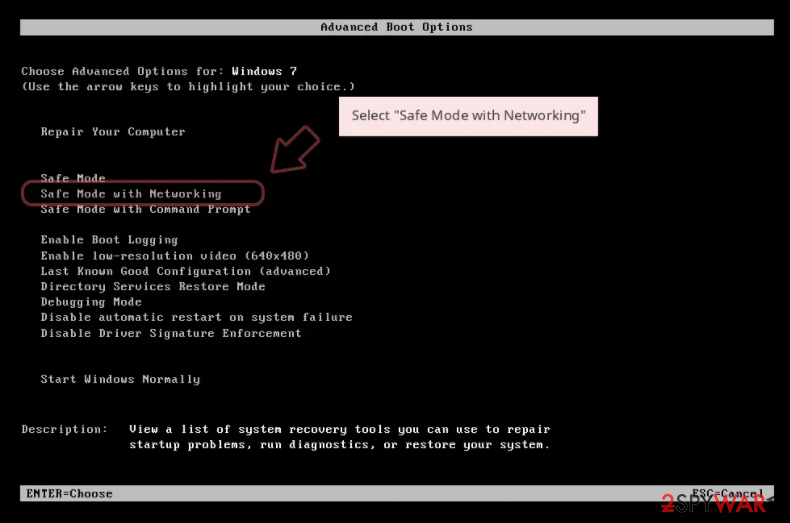
- When your computer becomes active, start pressing F8 button (if that does not work, try F2, F12, Del, etc. - it all depends on your motherboard model) multiple times until you see the Advanced Boot Options window.
- Select Safe Mode with Networking from the list.
Windows 10 / Windows 8
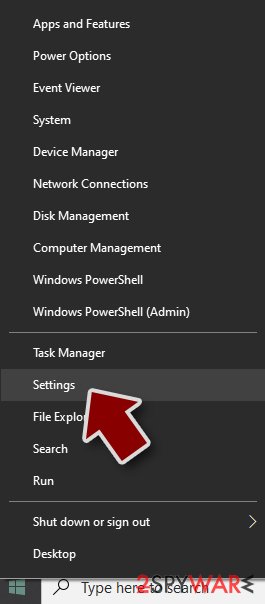
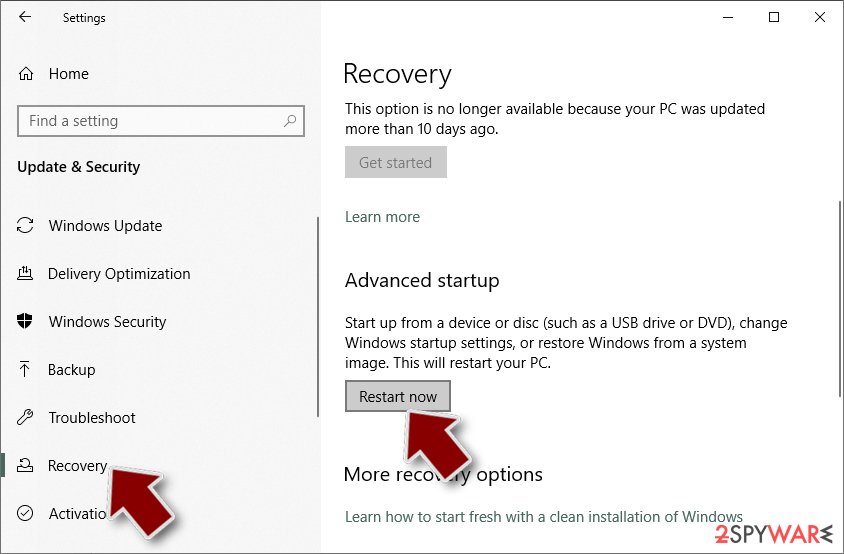
- Right-click on Start button and select Settings.
- Scroll down to pick Update & Security.
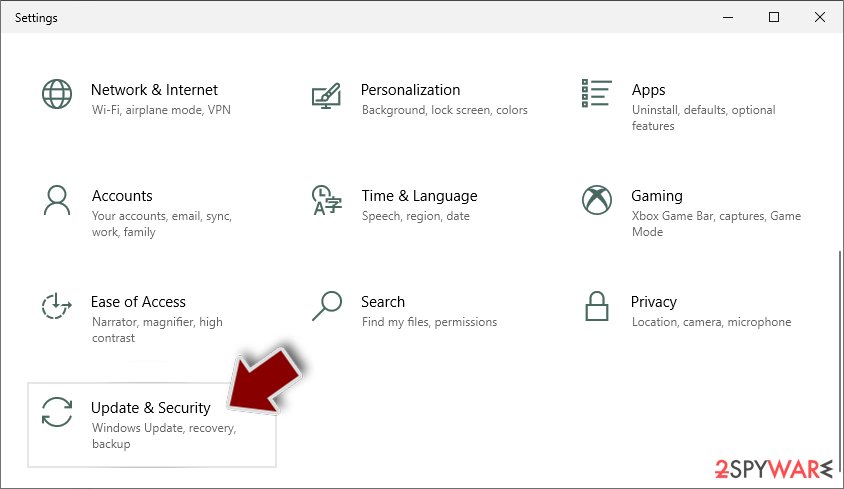
- On the left side of the window, pick Recovery.
- Now scroll down to find Advanced Startup section.
- Click Restart now.
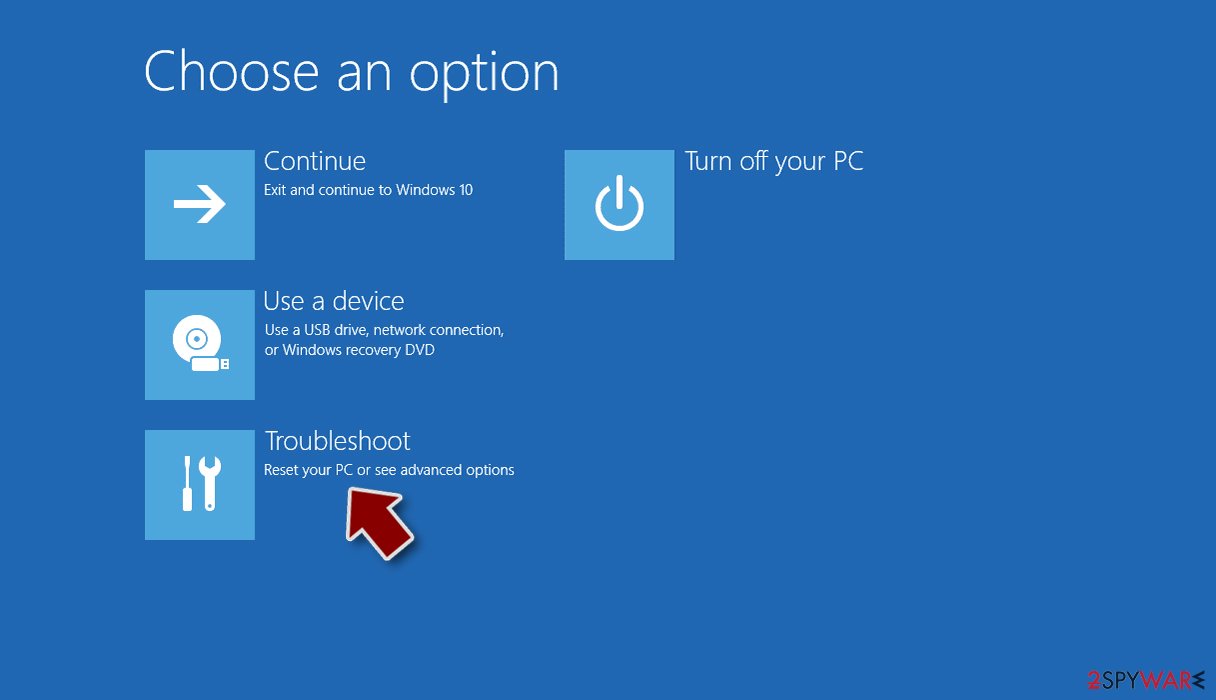
- Select Troubleshoot.
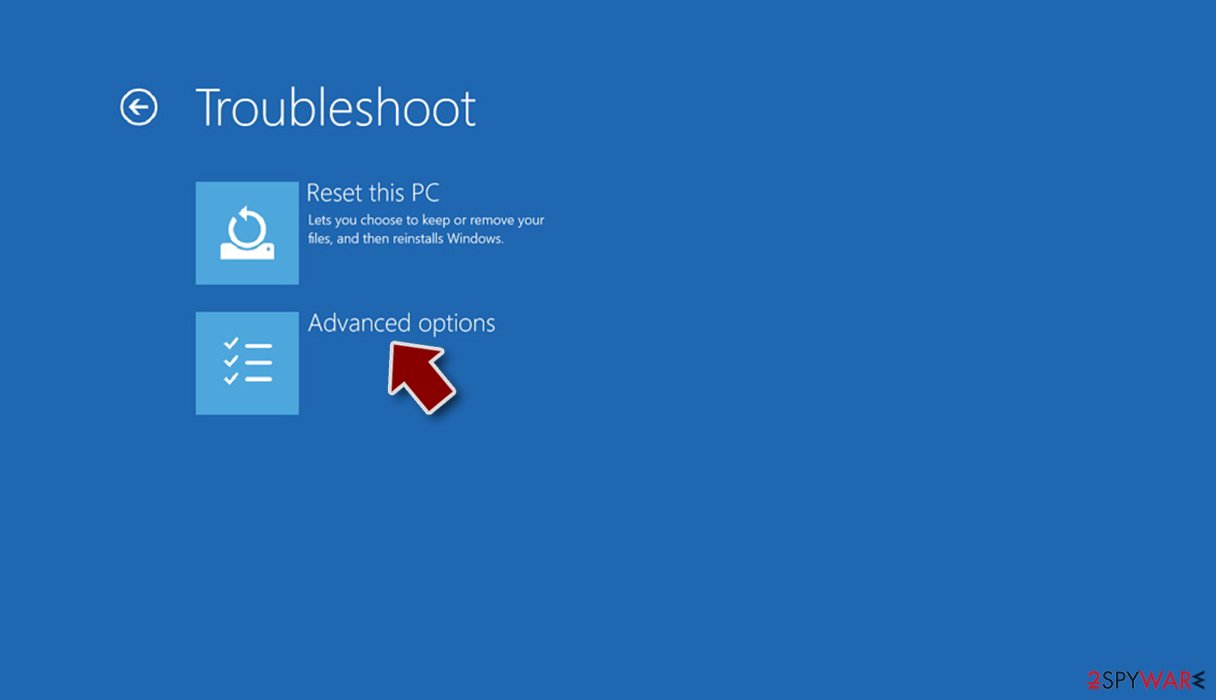
- Go to Advanced options.
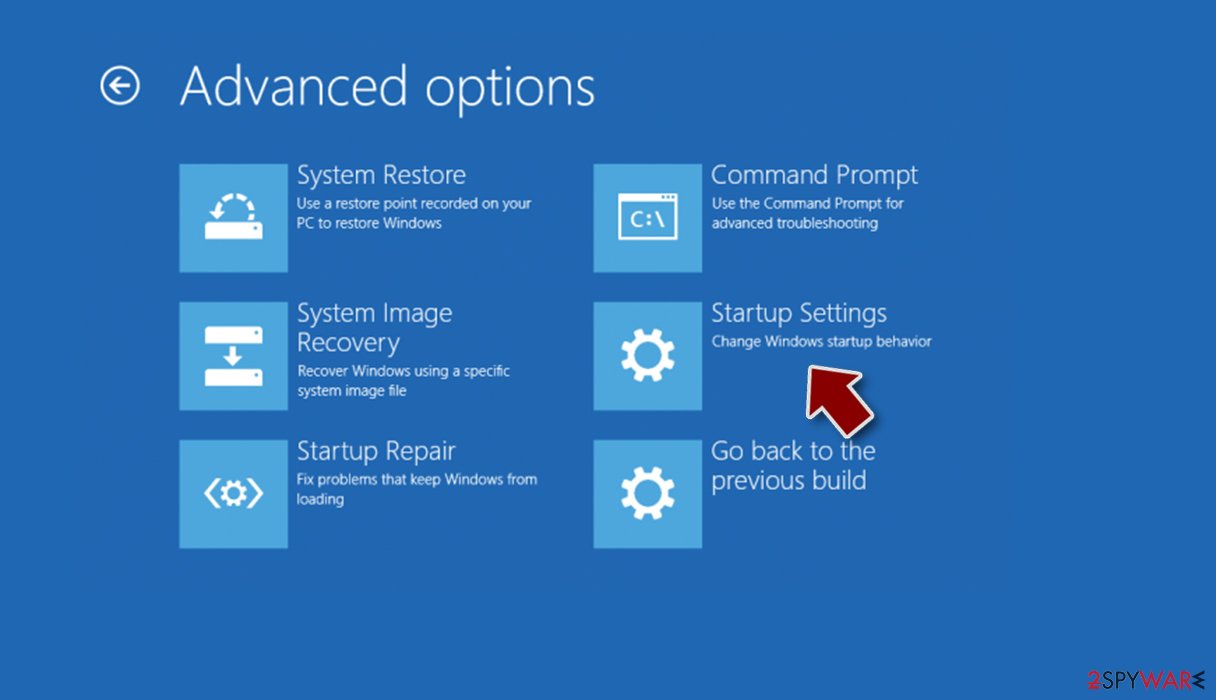
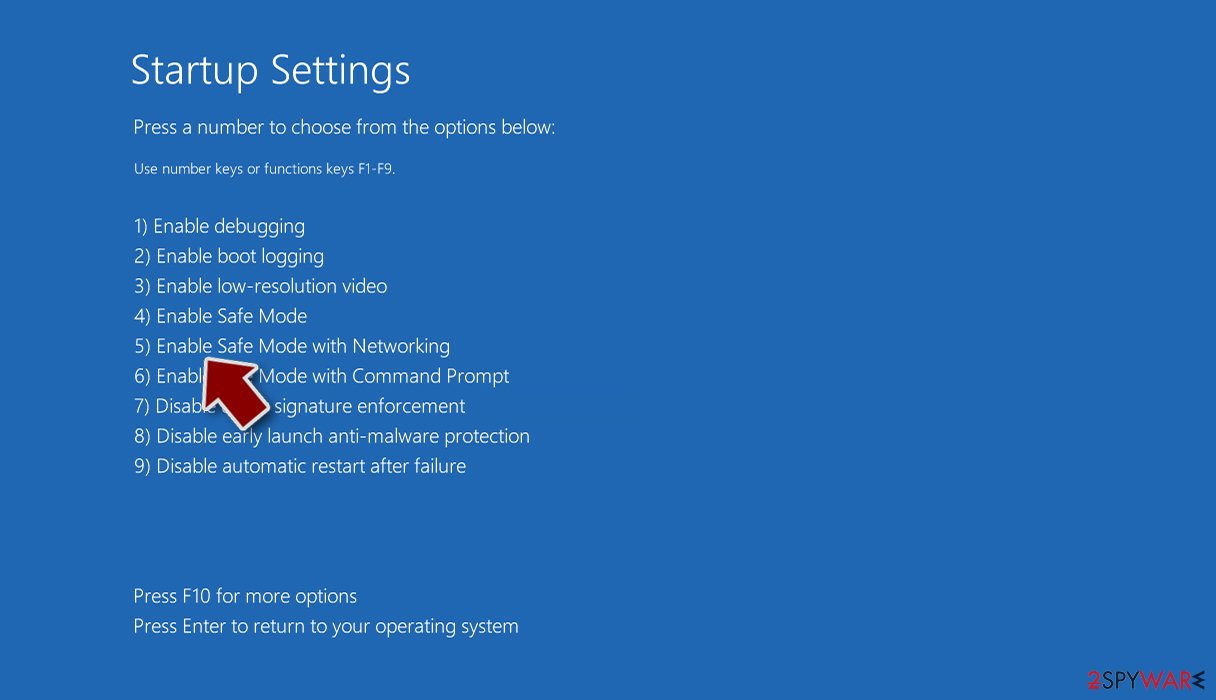
- Select Startup Settings.
- Press Restart.
- Now press 5 or click 5) Enable Safe Mode with Networking.
Step 2. Shut down suspicious processes
Windows Task Manager is a useful tool that shows all the processes running in the background. If malware is running a process, you need to shut it down:
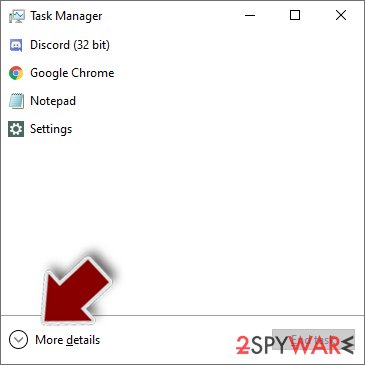
- Press Ctrl + Shift + Esc on your keyboard to open Windows Task Manager.
- Click on More details.
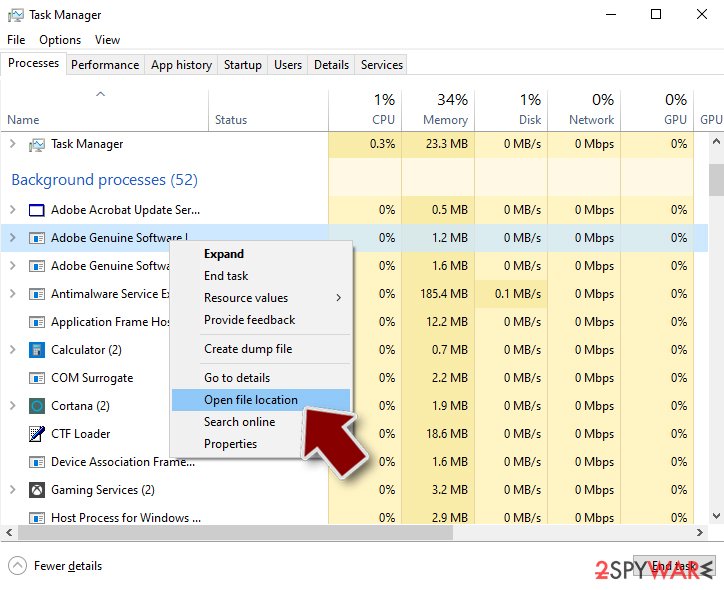
- Scroll down to Background processes section, and look for anything suspicious.
- Right-click and select Open file location.
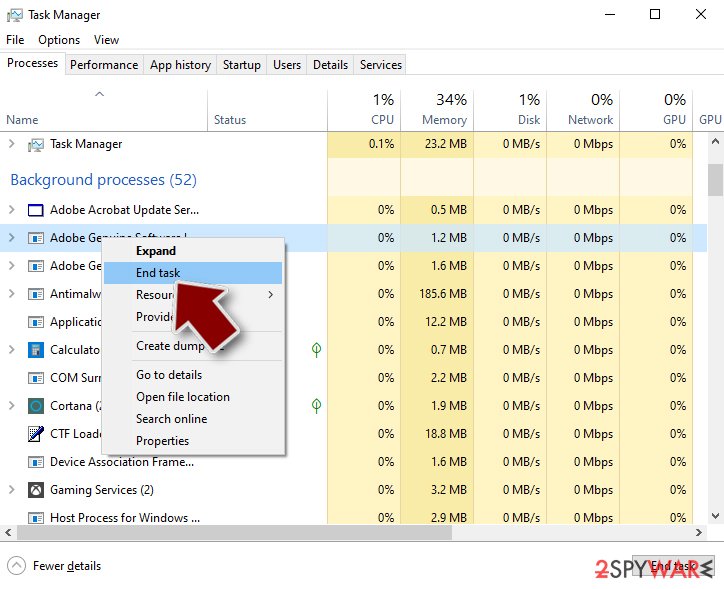
- Go back to the process, right-click and pick End Task.
- Delete the contents of the malicious folder.
Step 3. Check program Startup
- Press Ctrl + Shift + Esc on your keyboard to open Windows Task Manager.
- Go to Startup tab.
- Right-click on the suspicious program and pick Disable.
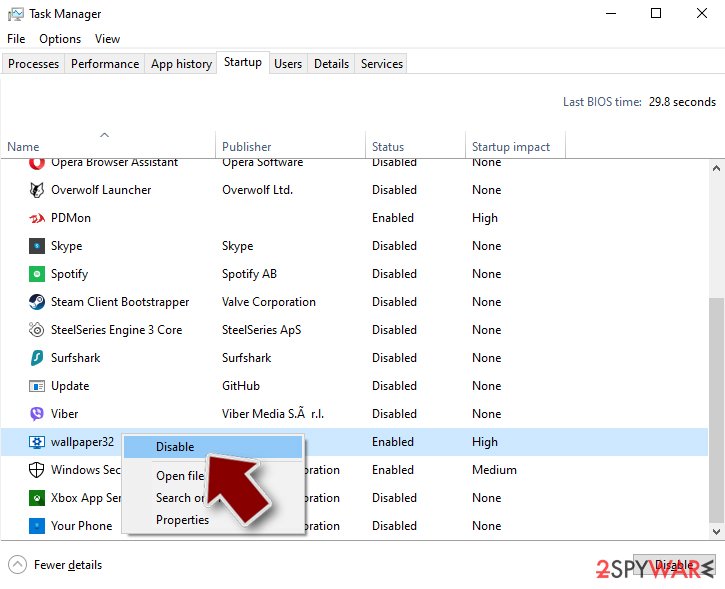
Step 4. Delete virus files
Malware-related files can be found in various places within your computer. Here are instructions that could help you find them:
- Type in Disk Cleanup in Windows search and press Enter.
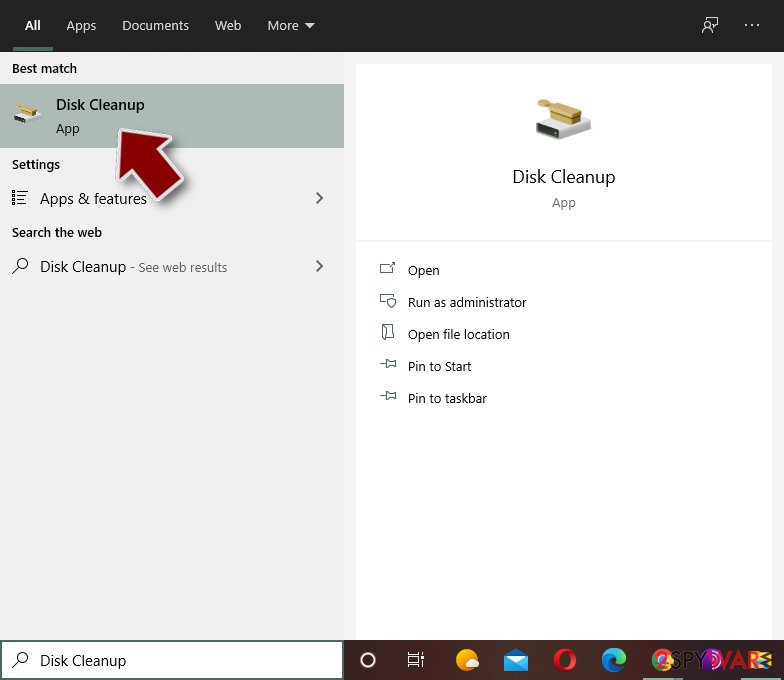
- Select the drive you want to clean (C: is your main drive by default and is likely to be the one that has malicious files in).
- Scroll through the Files to delete list and select the following:
Temporary Internet Files
Downloads
Recycle Bin
Temporary files - Pick Clean up system files.
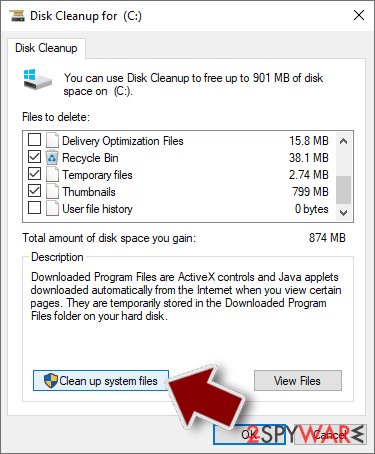
- You can also look for other malicious files hidden in the following folders (type these entries in Windows Search and press Enter):
%AppData%
%LocalAppData%
%ProgramData%
%WinDir%
After you are finished, reboot the PC in normal mode.
From our report of Jan 2021 · not reviewed since
TrojanDownloader:HTML/Adodb.gen!A removal process
As evident, if you have robust security software installed, you should remove TrojanDownloader:HTML/Adodb.gen!A as soon as it is flagged.
This is especially important if you have recently clicked on a seemingly innocent link or downloaded a picture or another file to your computer via the Discord app. If not taken care of, the threat could lead to remote code execution by the attackers, who could technically install anything in your machine without you knowing.
If your security software is incapable of performing a permanent TrojanDownloader:HTML/Adodb.gen!A removal (for example, the identification shows up every time) you should perform a full system scan with security software, such as . Since the malicious script is written in HTML, it is also important to clean all your web browsers to ensure that no leftovers are present on the device.
[GI=method-1]If the virus is interfering with your security software, you should access Safe Mode with Networking and perform a full system scan from there:
After removal: passwords, accounts and prevention
Secure your accounts after the clean-up
Assume that whatever was saved in the browsers on this PC while the PC showed an unfamiliar process called TrojanDownloader.VBS in Task Manager has been copied:
- passwords
- cookies
- autofill data
Work from a clean device, or from this PC once the offline scan finds nothing.
Start with your main e-mail account, because it can reset everything else, then banking and payment, then social and gaming accounts. Change each password, sign out of all sessions and turn on two-step verification: Turn on two-step verification / secure a hacked account.
The full order, including crypto wallets and card replacement, is in securing your accounts after malware.
Choose a proper web browser and improve your safety with a VPN tool
Online spying has got momentum in recent years and people are getting more and more interested in how to protect their privacy online.
One of the basic means to add a layer of security - choose the most private and secure web browser. Although web browsers can't grant full privacy protection and security, some of them are much better at sandboxing, HTTPS upgrading, active content blocking, tracking blocking, phishing protection, and similar privacy-oriented features.
However, if you want true anonymity, we suggest you employ a powerful VPN - it can encrypt all the traffic that comes and goes out of your computer, preventing tracking completely.
Lost your files? Use data recovery software
While some files located on any computer are replaceable or useless, others can be extremely valuable.
Family photos, work documents, school projects - these are types of files that we don't want to lose. Unfortunately, there are many ways how unexpected data loss can occur:
- power cuts
- Blue Screen of Death errors
- hardware failures
- crypto-malware attack
- even accidental deletion
To ensure that all the files remain intact, you should prepare regular data backups. You can choose cloud-based or physical copies you could restore from later in case of a disaster. If your backups were lost as well or you never bothered to prepare any, can be your only hope to retrieve your invaluable files.
Questions about TrojanDownloader:HTML/Adodb.gen!A
Is TrojanDownloader.VBS safe?
It depends on where the file is and who signed it, not on the name. Open Task Manager, go to the Details tab, right-click TrojanDownloader.VBS and choose Open file location. A file inside Program Files or System32 with a valid digital signature from a known company is usually part of a legitimate program.
A file in AppData, Temp or ProgramData with no signature, especially one that restarts itself after you end it, is suspicious. If you cannot tie the process to anything you installed, uninstall recent unfamiliar programs and run a Microsoft Defender Offline scan.
What does the name TrojanDownloader:HTML/Adodb.gen!A tell me?
Microsoft builds names in a fixed order:
- category
- then platform
- then family
- sometimes followed by a variant letter
- a suffix
The category is the most useful part for you. Trojan, Backdoor and PWS mean real malware that can download more, give remote access or steal passwords. PUA means unwanted software.
Ransom means ransomware. Suffixes such as !ml or !MTB mean the detection came from machine learning or behaviour analysis. Search for the family part of TrojanDownloader:HTML/Adodb.gen!A together with the word Microsoft to find its entry in Microsoft's security encyclopedia.
Can I end TrojanDownloader.VBS in Task Manager?
Ending an unknown process is safe in the sense that Windows will warn you before you close anything critical, and a restart brings back whatever Windows needs. Ending TrojanDownloader.VBS will not remove it, though: if a task or startup entry launches it, it returns at the next sign-in.
Use ending the process as a test. If something important stops working, it belonged to a program you use. If nothing changes and it comes back by itself, find and disable its starter, delete the file and scan the PC.
Should I change my passwords after TrojanDownloader:HTML/Adodb.gen!A?
It depends on the category and on whether the file ran. If the name begins with PWS, Spy, Backdoor or Trojan and the file sat in AppData, ProgramData or Temp, assume it ran and change your important passwords from a different device, starting with e-mail, then banking.
Sign out of all sessions too. If TrojanDownloader:HTML/Adodb.gen!A is a PUA or was caught in Downloads before you opened anything, a password change is a precaution rather than a must. When in doubt, change the e-mail password and turn on two-step verification; it is quick and protects everything else.
Can I just delete TrojanDownloader.VBS?
Deleting TrojanDownloader.VBS by hand rarely removes TrojanDownloader:HTML/Adodb.gen!A. While the trojan runs, Windows may refuse to delete the file, and if you succeed, a scheduled task, a service or a second copy may bring it back at the next restart.
The file can also be only one part of the infection: loaders and remote access tools often install other programs. Use the Microsoft Defender offline scan, which removes the file together with its startup entries before Windows loads, and then check startup items and scheduled tasks as described in the plan.
Will Windows Security detect TrojanDownloader:HTML/Adodb.gen!A?
Yes, current Microsoft Defender definitions name it TrojanDownloader:HTML/Adodb.gen!A. Make sure the definitions are up to date first: open Windows Security > Virus & threat protection > Protection updates and click Check for updates. Then run a full scan and the Microsoft Defender offline scan.
If the detection comes back after you remove it, look for the program, task or extension that brings it back, using the plan above. Detection removes files and startup entries, but it does not reverse changes TrojanDownloader:HTML/Adodb.gen!A already made, so follow the other steps in this guide as well.
Which malware family is TrojanDownloader:HTML/Adodb.gen!A?
That is not known yet. TrojanDownloader:HTML/Adodb.gen!A has been reported by people who saw an unfamiliar process called TrojanDownloader.VBS in Task Manager, but no sample has been analysed publicly, so security companies have not assigned it to a family. The name you see may be a file or program name chosen by the authors, not a family name.
This does not stop you from removing it: the startup points, the offline scan and the account steps are the same for most families of this type. If Microsoft Defender or another scanner gives the file a detection name, write it down; that name is the best clue to the family and is useful when you report the incident.
Should I reset my PC because of TrojanDownloader:HTML/Adodb.gen!A?
Only if the signs point to deeper access. Reset when you see an unfamiliar process called TrojanDownloader.VBS in Task Manager again after removal, when Windows Security cannot start or update, when remote access tools you did not install keep appearing, or when you simply cannot trust the PC any more.
Otherwise, the plan in this guide plus an offline scan is enough. If you do reset, choose Remove everything and Cloud download for a fresh copy of Windows, restore only documents and photos, and reinstall programs from their official sites. Change important passwords from the clean system afterwards.
How dangerous is TrojanDownloader:HTML/Adodb.gen!A?
Treat it as serious until proven otherwise. The visible sign is an unfamiliar process called TrojanDownloader.VBS in Task Manager, and programs that behave this way often have more abilities than they show:
- copying passwords
- downloading other malware
- giving remote access
Its family is not known yet, so nobody can say which of these it uses. The good news is that the response is the same in every case and takes about an hour:
- cut the network
- remove the startup entry
- run an offline scan
- change passwords from a clean device
If someone had remote control, a full reset is safer.
Will Fortect remove TrojanDownloader:HTML/Adodb.gen!A?
Fortect scans Windows for malware and unwanted programs and repairs the system files and settings they change, and its free scan shows what it finds on your PC before you decide anything.
For TrojanDownloader:HTML/Adodb.gen!A, follow the plan above as well: the browser steps take back permissions and settings that no scanner treats as a threat, and uninstalling the program that brought it removes the source.
Run Microsoft Defender's full scan and, if anything was found, its offline scan as a second opinion. If the symptoms are gone after the plan and both scans are clean, there is nothing more to do.
Sources
- FTC: How to recognize, remove and avoid malware (read October 6, 2026)
- Microsoft Learn: Microsoft Defender Offline (read October 6, 2026)
- Microsoft Learn: How Microsoft names malware (read October 6, 2026)