
Open-fast.com: what the greeting-card site and its WhatsApp share button do
Open-fast.com is a greeting-card website that turns a name you type into a card and a ready-made WhatsApp message; it is not a virus and installs nothing. Delete a message you shared, turn on WhatsApp two-step verification if you typed a code anywhere, and remove adware only if redirects continue.
Facts checked October 6, 2026. Removal steps tested on Windows 11 (26H2) and checked against Microsoft's and the browser makers' current documentation.
Automatic
Get a free scan and check if your PC is infected.
Fortect finds malware, unwanted programs and the Windows damage they leave behind, and repairs it in one pass.
Do it yourself · free Remove Open-fast.com yourself 2 steps, about 6 minutes, no software needed.
Start the steps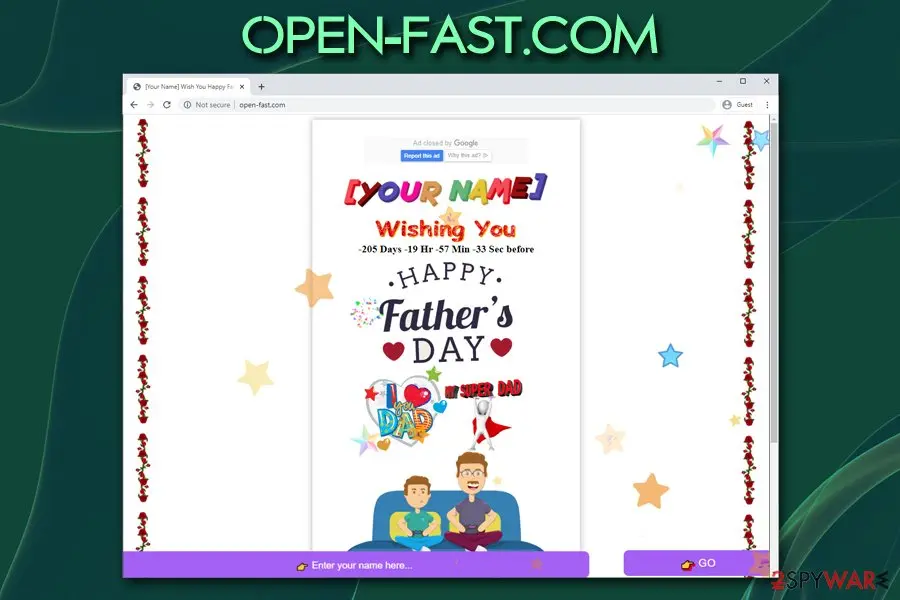
Open-fast.com: summary
| Type | Greeting-card website with a WhatsApp and Facebook share button and Google ads; not a virus and not a program |
|---|---|
| Risk | Medium: a chain message is sent in your name and the ads are not under our control; no harm to a device and no login request seen on one visit |
| Symptoms | A card page with a name box and Go button; a Share button that opens WhatsApp with "Have you seen this???" and a link; for some readers, redirects to the site |
| How to get rid of it | Nothing to uninstall for the site; delete a message you shared, turn on WhatsApp two-step verification, and remove extensions or programs if redirects continue |
| Our check (6 October 2026) | One desktop visit from Lithuania: no notification request, pop-up or redirect; one name field; Google AdSense and Ad Manager; an obfuscated script we did not decode |
| Running since | Domain registered 15 May 2018; our first guide is from 7 January 2020; the site was last changed in January 2024 |
| Removal | Scan the PC with security software to find and remove the malware and anything installed with it. Fortect scans Windows for malware and repairs the system files and settings it damaged. Remove it nowTo use the full-featured product, you have to purchase a license for Fortect. The scan is free. |
Show 9 more facts
| Name | Open-fast.com |
|---|---|
| Evidence | One write-up by a security site; details still limited |
| Arrives as | WhatsApp share link |
| Pretends to be | A friend's greeting |
| Claim | A surprise message from a friend with a greeting card |
| Link leads to | open-fast[.]com |
| Asks for | A name, then a share to your contacts |
| First seen | 7 January 2020 |
| Facts checked | 6 October 2026 |
Facts checked on 6 October 2026 by one desktop visit to open-fast.com (home page, a card page and its share page) from Lithuania, the RDAP record and WhatsApp's help pages (search excerpts). We did not tap the share link inside WhatsApp, did not decode the site's obfuscated script and could not read the 2020 pages the old guide described.
What Open-fast.com is
Open-fast.com is a greeting-card website, not a virus and not a program. You type a name, it shows a festival card with that name on it, and a Share button prepares a ready-made message for WhatsApp that carries a link back to the site. The risk is the chain of messages and the ads, not an infection of your device.
- 1
You open a card page
Today's home page lists five cards: Happy New Year 2024, Merry Christmas, Valentine's Day, Women's Day and Easter. In 2020 the one card was a Father's Day card, and the old guide described a page with a name box and a Go button.
- 2
You type a name and press Go
The form on the card page sends only that name to a second page, share.html, in the address (share.html?n=name). It has one field, and we found no field for a phone number, a password or a card.
- 3
The Share button builds a message
On a phone the button is a whatsapp:// link with the text already written, ending in a link to the card with your name in it. On a computer there are share icons for Facebook and WhatsApp Web. Nothing is sent until a person taps Send in WhatsApp.
- 4
The person who receives it opens the card
They land on the same site, see ads from Google's ad systems, and are offered the same name box and Share button. That is how the site spreads without any program being installed.
- What it is
- A greeting-card site with a WhatsApp and Facebook share button, supported by Google ads
- What it is not
- A virus, a program or a WhatsApp login page, on what we read on 6 October 2026
- What it asks for
- A first name, typed into one box
- Where it shows
- Any browser; the share button is aimed at WhatsApp on a phone
- Why people worry
- The old guide called it a scam that could hijack WhatsApp or sign people up for premium SMS; we found no sign of either (see the test below)
What the Open-fast.com message looks like
Have you seen this???
[name] send you a surprise message
Open this
open-fast.com/card/ny1/?n=[name]
How to tell the Open-fast.com message is fake
The message the Share button writes
The text in the share link is the part worth reading, because it is what your contacts receive under your name. It is written to make people tap, with an arrow row and the words "open this", the same pattern chain messages use.
| 2020 (old guide's screenshot) | 6 October 2026 (share page source) | |
|---|---|---|
| First line | I'm *name* | Have you seen this??? |
| Second line | open this once | name send you a surprise message |
| Call to action | pointing-hand marks, then the link | *Open this*, then down-arrow marks |
| Link | open-fast.com/?n=name | open-fast.com/card/ny1/?n=name (the card's own address) |
| Opens | WhatsApp with the text typed in | WhatsApp (phone); WhatsApp Web and Facebook share (computer) |
The old guide wrote that the link "changes the status" by a background script and that this could get people registered to a premium SMS service or take over their WhatsApp. A whatsapp://send link only opens the chat chooser with the text filled in; it does not post a status and does not read your account. We did not find a premium SMS step, and WhatsApp's own help pages say account takeover happens when someone gets your six-digit registration code, not from a share link.
Sample card wording quoted in the old guide
- Name, Wishing you happy Father's day!
- God gave me the greatest gift I ever had, God gave me the best friend in the form of my dad.
- Father's Day wishes for a dad who is one in a million!
- Wishing you a very Happy Father's Day.
These are ordinary greeting lines. Today's cards use New Year, Christmas, Valentine, Women's Day and Easter wishes.
How to spot a scam site: the old guide's tips, corrected
Our 2020 guide ended with general advice that is still right. This version keeps it and fixes what was overstated: greeting-card sites are not all frauds, and no "industry experts" are named behind the tips.
Scams change their shape every year. Our old pages named push-notification pages such as Sauwoaptain.com, tech-support scams such as "Your system is infected" and rogue optimizers such as Mac Tonic as earlier examples. They share a goal: to make you spend money or hand over private data that can be sold. Open-fast.com is different in what we read, because it asks only for a name; what it shares with the scams is the push to tap and pass it on.
| Tip | Why it holds |
|---|---|
| A company logo on a page proves nothing | Logos are copied; a claim of a Microsoft or Apple partnership needs proof on the company's own site |
| No website can scan your device for viruses | A page cannot see the files on your computer; only a program you installed can, so ignore "virus detected" pages |
| Real malware detection needs a security program on the device | Windows includes Microsoft Defender; a second trusted tool is optional |
| Microsoft and Apple do not phone you out of the blue | Neither company calls to say your device is infected |
| Error messages from tech companies do not carry a support phone number | A number shown on a web page alert is the scammer's |
| A free iPhone or a similar prize is a scam | Check the retailer's own website for the offer; a giveaway you never entered did not choose you |
| Do not enter card details to claim something free | A "free" offer that wants a card is how trial subscriptions and card theft start |
| Be careful with sites that offer random services | The old guide said to stay away from unknown greeting-card sites; the better rule is to use a known service and not to forward links that ask people to "open this" |
How to keep chain-message sites and scams out
Do
- Use a first name or nickname if you try a card site, and nothing more.
- Check the link a message carries before you open it, and ask the friend if they really sent it.
- Turn on two-step verification in WhatsApp and add the recovery e-mail it asks for.
- Check your phone bill for charges you do not recognise.
- Keep browsers and extensions up to date, and install extensions only from the browser's own store.
Don't
- Do not forward a message that says "open this" or "surprise" to your contact list.
- Do not type a WhatsApp six-digit code anywhere except in the app, and never give it to anyone who asks.
- Do not allow notifications from a greeting-card or a prize site.
- Do not install an app or call a number because a page says your device is infected.
- Do not pay or enter card details for a service that says it is free.
Is Open-fast.com dangerous? What the senders want
What we checked on 6 October 2026, and what we could not
We opened the home page, one card page and its share page in a desktop Chromium browser from Lithuania, and read the page source of the share page. That is one visit from one country on one device, so everything below reads as "nothing on this one visit".
open-fast.com · one visit · 6 October 2026
- Notification requestNone on this visit, and no service worker registered. Adware sites can ask only on a second visit, after a click or for one country, which one visit cannot rule out.
- Pop-ups, new tabs and redirectsNone on this visit: the address stayed open-fast.com/ and nothing opened beside it. A different country, device or referrer may see something else.
- Fields asked forThe name form has one text field (up to 50 characters). We saw no password, WhatsApp code, phone number or card field on the three pages.
- Share buttonA whatsapp:// link on phones with a preset text and a link to the card, plus Facebook and api.whatsapp.com links on a computer. It only opens a prepared message. We did not tap it inside WhatsApp, so how it looks on a phone is our reading of the link.
- Ads and trackersGoogle AdSense and Google Ad Manager (doubleclick.net, googlesyndication.com), Google Tag Manager and Google Analytics. Ads from an ad network change from visit to visit, and we cannot say what one will show you.
- Site scriptThe cards load App.min.js from cdn.jsdelivr.net. It is obfuscated and we did not decode it. The browser test showed no redirect or pop-up, but that is all the test can say about it.
- Premium SMSNo sms: link, phone field or subscription page on the pages we read. This does not prove it never did what the old guide said in 2020; the 2020 pages are gone.
- Site careThe footer says 2023, the cards are New Year 2024, and the server reports the home page last changed on 7 January 2024. The domain was registered on 15 May 2018 through GoDaddy and its record was changed on 30 May 2026 (RDAP). The site looks unattended, not shut.
A chain-message and ad site, not a virus; one visit does not clear it We saw no harm to a device and no request for a login on this one visit, so the old warning about a hijacked WhatsApp account is not what the pages show today. What remains is real but smaller: a pre-written message that carries your chosen name to your contacts, and ads from a network we cannot vouch for. Because ad-driven sites behave differently by country, device and visit, treat a redirect or a pop-up you see as separate from this test.
How the site looked in 2020 and what changed
15 May 2018
The domain is registered
RDAP gives the registration date and GoDaddy as registrar. Our old guide, written two years later, says nothing about who runs the site.
7 January 2020
Our first guide
The guide called the site a cheaply designed greeting-card service that could lead to personal data disclosure. It described a Father's Day card with a name box, which fits the one card the site offered at the time.
June 2020
The Share button and a second look
Our June 2020 update added two screenshots. The left window is a card page at open-fast.com/ready.php with a green bar "Click here to share on Whatsapp" and the link shown in the status bar; the right is a dark animated page with a figure and the words "Touch Me!". The picture is from the old guide, not from our 2026 test.
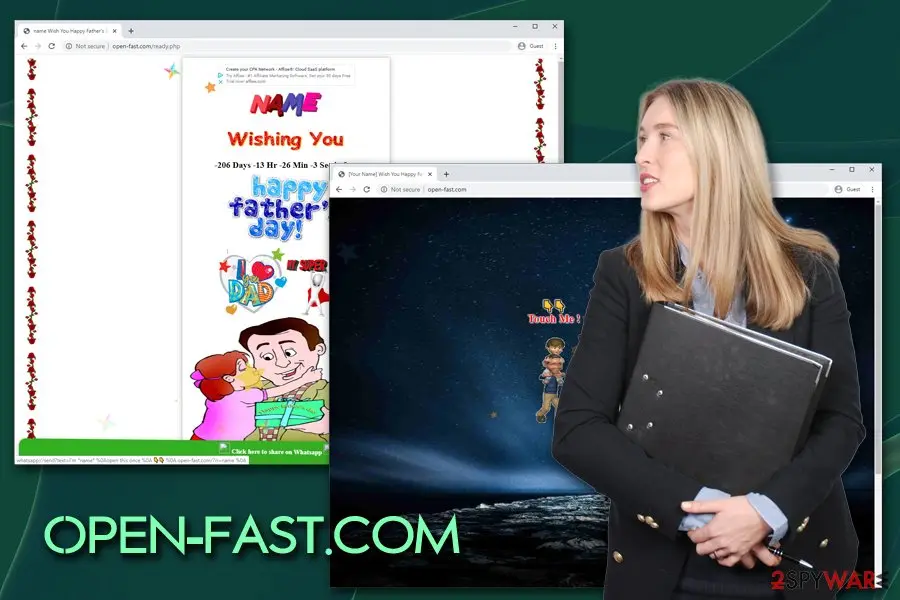
Two windows from our 2020 guide. Left, a card page at open-fast.com/ready.php with a green "Click here to share on Whatsapp" bar; right, a dark animated page with "Touch Me!". The woman is stock art added by the old guide. June 2020
The message in the status bar
This screenshot shows the My Hero card with the pointer on the share button, and the status bar spells the link out: whatsapp://send?text=I'm *name* %0Aopen this once %0A open-fast.com/?n=name. The old guide read this as a script that changes your WhatsApp status; the link only opens WhatsApp with this text typed in.
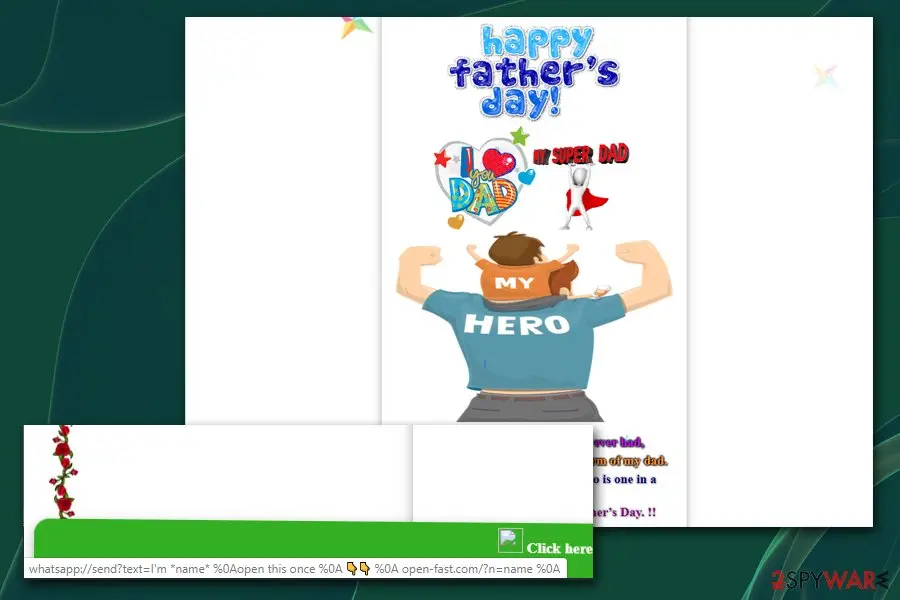
A 2020 screenshot from the old guide: the My Hero card, a green share bar and the whatsapp://send link in the status bar. 7 January 2024
The last change we can see
The home page's Last-Modified header reads 7 January 2024, and the cards are New Year 2024 and Christmas. The new share text begins "Have you seen this???" and ends with "Open this".
6 October 2026
Our test
The site still answers with status 200 and the same five cards. It sent no notification request and opened no pop-up on our visit.
What can actually go wrong, from most to least serious
Nothing here installs anything. The harm comes from what you do after the page: sharing, typing a code somewhere, or following an ad.
- High
A WhatsApp registration code or PIN typed on another page
This is how WhatsApp accounts are taken over, by tricking you into giving the six-digit code, and it is separate from this site: the pages we read never asked for it. If you gave one anywhere, follow the account steps below at once.
- Medium
A chain message sent in your name
Share sends your contacts a text that tells them to open a link, from you. They get ads and the same name box, and some will think it came from a hacked account. Delete the message and tell those you sent it to.
- Medium
Ads from an ad network
The site runs Google ad slots, and an ad is not the site's own content. We saw nothing bad on one visit. A redirect, a pop-up or a notification request on your device is more likely adware or a different site; see below.
- Low
Your chosen name in a link
The name goes into the address (?n=name) and into the message. It is not secret, so use a first name or nickname, never a full name, address or phone number.
- Low
Premium SMS charges
We found no phone field or sms: link, and our one visit cannot prove the site never did this. A premium service shows up on the phone bill as a charge or a subscription. If you see one, your operator can stop and refund it; check the bill before worrying.
Redirects and pop-ups: this site or something on your device?
The old guide said that frequent redirects to Open-fast.com could mean an adware infection. We saw no redirect from the site itself on our visit, so the question is which end the redirects start from.
| What you see | What it usually means | What to do |
|---|---|---|
| You opened a WhatsApp link from a contact and landed on the card | The chain message working as intended | Do not forward it; delete the chat message |
| Open-fast.com or another site opens by itself, again and again | An ad, extension or program on the device or a site you came from is sending you there (old guide: adware) | Check extensions and installed programs, then run the removal steps below |
| A changed home page or search engine, many ads on every site | A browser hijacker or adware program | Remove the program and extension, then reset the browser |
| A pop-up asking you to allow notifications from open-fast.com | Not seen in our test; a different page or an ad may have asked | Press Block, and remove the site from the allowed list if you pressed Allow |
| Slow computer, crashes or error messages | Not a sign of this site (we found no program); many things cause it | Update, restart and scan; this page cannot name a cause |
If you replied or paid
Match the step to what you did. If you only opened the site, nothing is needed beyond closing the tab.
- 1
If you only looked at the card
Close the tab. Nothing was installed, and the old guide's advice to uninstall or scan applies only if redirects or ads keep appearing.
- 2
If you shared a card on WhatsApp
Open the chat, press and hold the message, and use Delete for everyone if it is still within WhatsApp's time limit. Tell the people you sent it to that it is a chain greeting and that nobody needs to open it.
- 3
If you typed a WhatsApp code or PIN on a page
Open WhatsApp, go to Settings > Account > Two-step verification and switch it on, so a stolen code alone cannot register your number on another phone. Then open More options > Linked devices and use Log out on any device you do not recognise (WhatsApp Help Center). The old guide said to change the WhatsApp password; WhatsApp has no password, only the registration code and the optional two-step PIN.
- 4
If you lost access to WhatsApp
Register your number again in the app and send the code the app sends you, never to someone else. WhatsApp's help page for a compromised account says you may be asked for a two-step PIN that the other person set; follow its instructions or contact WhatsApp support from the app.
- 5
If a charge appears on your phone bill
Contact your operator, explain the charge and ask them to cancel the subscription and block premium messages. The old guide said this too. If the bill is clean, there is nothing to cancel.
- 6
If you have redirects, ads or a changed home page
Remove extensions you did not choose (Remove a browser extension), remove any program you did not install () and reset the browser (Reset a browser and fix a hijacked search engine). Scan with Microsoft Defender and run an offline scan (Run a Microsoft Defender Offline scan). An anti-malware app, as the old guide suggested, is optional: the built-in tools cover the same steps.
- 7
If a page asked for notifications and you pressed Allow
Remove the site from the allowed list in each browser (Stop website notifications and pop-ups). The old Chrome, Edge, Firefox and Safari sections said the same in older menu names.
What to do about Open-fast.com
Stop all contact first.
If you sent money or documents, the later steps show how to limit the damage.
Step 1: Stop replying and keep the evidence
Do not reply, pay, or send documents, even to "cancel" or "verify" something: every answer marks you as a target worth more messages. Take screenshots of the messages, the sender address, the phone numbers and any payment details, then block the sender.
If you already sent money or an ID document, the next steps cover what to do. The screenshots work the same on a phone or on Windows 11 and Windows 10, where Windows + Shift + S captures part of the screen.
Full procedure with screenshots: What to do after paying a scammer
Step 2: Report it
A report takes ten minutes and helps take Open-fast.com down. Send it to ReportFraud.ftc.gov in the US (and ic3.gov when money was lost), to Action Fraud in the UK, or to your national police in the EU, with screenshots, sender details and any payment references.
Report the message inside the mail or chat app too. Keep a copy of everything until the case is closed, whether you use a phone or a Windows 11 or Windows 10 PC.
Full procedure with screenshots: Report a cyber attack or scam to the authorities
Questions about Open-fast.com
Is Open-fast.com a virus?
No, Open-fast.com is not a virus. It is a website, and a website cannot be installed on your device. On 6 October 2026 it showed five festival cards and a name box, loaded Google ads, and gave no pop-up or notification request on our one visit.
The risk lies in the Share button, which writes a chain-style message to your WhatsApp contacts, and in the ads. If redirects keep sending you there, the cause is more likely adware or a link you followed. One visit cannot clear the site, so keep removing anything you did not choose.
Is Open-fast.com a scam?
It is a chain-message and ad site, and we cannot call it a fraud in the sense of taking money. Our 2020 guide did call it a scam, because it feared premium SMS or WhatsApp hijacking.
We did not find either: the name form has one field and no phone number, password or card is asked for on the pages we read.
We could not read the 2020 pages, so we cannot say they never did. If you see charges on your phone bill, ask your operator to cancel them. Treat any page that asks for a WhatsApp code as a scam.
Can Open-fast.com hack my WhatsApp?
Not by itself, on what we read. The Share button is a link that opens WhatsApp with a message already typed; it does not post anything, read your account or change your status. WhatsApp accounts are taken over when someone gets the six-digit registration code, which WhatsApp tells users never to share.
The old guide's claim that the link changes the status through a background script does not fit the link in its own screenshot. Turn on two-step verification in Settings > Account if you want extra protection.
What happens if I click Share on WhatsApp?
WhatsApp opens with a prepared message and asks you to choose contacts; nothing is sent until you tap Send. On 6 October 2026 the text began "Have you seen this???", said your chosen name sent a surprise message, told people to open it and ended with a link to the card with your name in the address.
The people you send it to get the same card page, ads and Share button. If you already sent it, delete the message for everyone and tell the contacts it is only a greeting card.
How do I stop the redirects to Open-fast.com?
Find what is sending you there, because the site did not redirect us. Remove browser extensions you did not choose, remove programs you did not install, and reset the browser; the steps are in our removal plan. Then run a Microsoft Defender full and offline scan.
If the redirects happen only after tapping a link in a message, delete the message and do not open it. If they began after you installed free software, uninstall that software. Test with a second browser to see whether the problem follows the device or one browser.
Do I need to change my WhatsApp password?
There is no WhatsApp password to change. The old guide said to change it; WhatsApp signs you in with your phone number, a six-digit code sent by SMS or call, and an optional two-step verification PIN. If you only used the card site, do nothing.
If you typed a code on a page, open Settings > Account > Two-step verification and turn it on, then check Linked devices for any you do not know and log them out. WhatsApp's help pages explain recovery if you are locked out.
How can I stop premium SMS charges?
Call your mobile operator, point to the charge and ask them to cancel the subscription and block premium-rate messages. The old guide gave the same advice. Check the bill first: if there are no charges, no service was started.
We found no phone number box or sms: link on the Open-fast.com pages we read, so a charge more likely comes from another page or an app. Ask the operator which service name and short number billed you; that tells you where it started.
Is it safe to make a greeting card on Open-fast.com?
It is lower risk than the old warnings suggested, but not risk-free. The page asked for a name only, and we saw no pop-up or notification request on one visit, so a first name is a sensible limit. The ads come from Google's networks and change from visit to visit.
The Share button sends your contacts a message that tells them to open a link, which some will take for a hacked account. Choose a known card service if you want something with a stated owner, and do not use a full name.
Who owns Open-fast.com?
The public record does not say. The RDAP record shows the domain registered on 15 May 2018 through GoDaddy, with a change on 30 May 2026 and expiry on 15 May 2027, but no owner name.
The site's About and Contact pages give a generic festival text and an e-mail address hidden by the site's protection, and the footer reads 2023. We could not find the operator and do not guess. The pages look unattended: the home page was last changed in January 2024.
Will Fortect remove Open-fast.com?
Fortect scans Windows for malware and unwanted programs and repairs the system files and settings they change, and its free scan shows what it finds on your PC before you decide anything.
For Open-fast.com, follow the plan above as well: the browser steps take back permissions and settings that no scanner treats as a threat, and uninstalling the program that brought it removes the source.
Run Microsoft Defender's full scan and, if anything was found, its offline scan as a second opinion. If the symptoms are gone after the plan and both scans are clean, there is nothing more to do.
Sources
- Our old guide Open-fast.com, published 7 January 2020 and updated 29 June 2020 (the claims, the WhatsApp link, three screenshots) (read October 6, 2026)
- Our own check of open-fast.com on 6 October 2026: home page, card page card/ny1/, share page share.html?n=, privacy policy, About and Contact pages and the Last-Modified header (one desktop visit from Lithuania) (read October 6, 2026)
- RDAP record for open-fast.com (registered 15 May 2018, GoDaddy.com, LLC, changed 30 May 2026, expires 15 May 2027) (read October 6, 2026)
- WhatsApp Help Center: How to recover a compromised account (search excerpt read, page not opened in full) (read October 6, 2026)
- WhatsApp Help Center: Account security tips (Linked devices check; search excerpt read) (read October 6, 2026)
- WhatsApp Help Center: About two-step verification (search excerpt read) (read October 6, 2026)
- WhatsApp Help Center: How to check devices linked to your account and unlink a device (More options > Linked devices > Log out; search excerpt read) (read October 6, 2026)
- WhatsApp Help Center: How to manage two-step verification settings (Settings > Account > Two-step verification; search excerpt read) (read October 6, 2026)
- WhatsApp Help Center: Seeing "You have been logged out for your account security" (never share the 6-digit registration code; search excerpt read) (read October 6, 2026)