
Synapse X.exe, Synapse X: what it is and how to remove it
Synapse X.exe is either a legitimate 2016 scripting tool or malware disguise, with malicious versions acting as coin miners or RATs. Both legitimate and fake versions require careful verification.
Facts checked October 13, 2026. Removal steps tested on Windows 11 (26H2) and checked against Microsoft's and the browser makers' current documentation. Sections marked as our earlier report are the original text: they describe the threat as it was then and have not been reviewed since. The 2026 status, the removal steps and the questions are current.
Automatic
Get a free scan and check if your PC is infected.
Fortect finds malware, unwanted programs and the Windows damage they leave behind, and repairs it in one pass.
An automatic scan can look at X.exe and the other programs installed around the same time.
Do it yourself · free Remove Synapse X.exe, Synapse X yourself 3 steps, about 9 minutes, no software needed.
Start the steps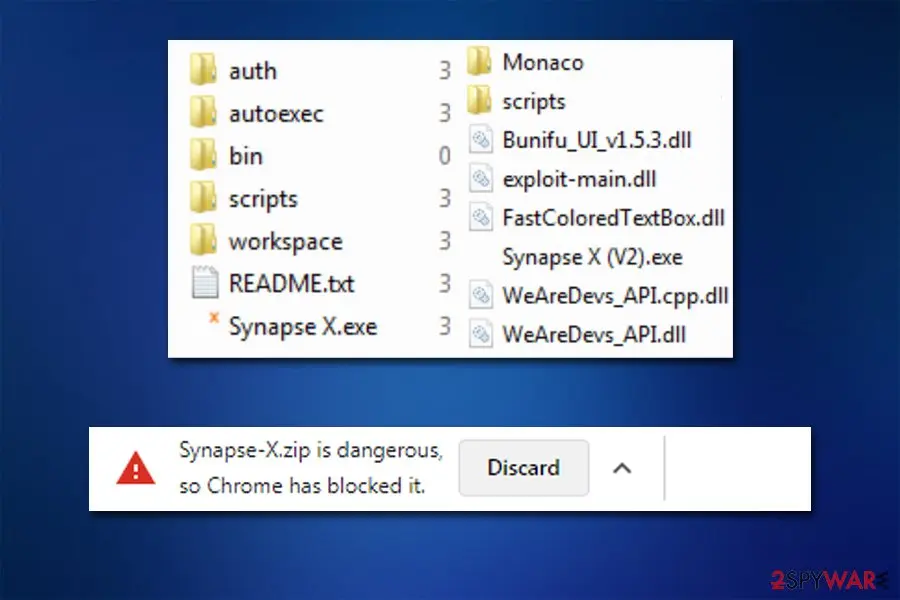
Synapse X.exe, Synapse X: summary
| Damage | The original application is not malicious, although various anti-malware tools could flag it as a false positive. Fake versions could represent a variety of infections, and can cause significant financial losses, sensitive information disclosure, file loss, increased electricity bills, computer performance deterioration, random crashes and reboots, etc. |
|---|---|
| Name | Synapse X.exe, Synapse X |
| Type | Malware (Coin Miner, RAT, Data Stealer) or scripting software/tool |
| Infiltration | Malware can be distributed in a variety of different methods, including exploit kits, malvertising, spam emails, software cracks, and much more |
| Related malware | The fake processes of synapse x.exe might represent such infections as Orcus RAT, CoinMiner, Discord malware Spidey Bot, and many others |
| Detection names | No Microsoft detection name is known |
| Removal | Scan the PC with security software to find and remove the malware and anything installed with it. Fortect scans Windows for malware and repairs the system files and settings it damaged. Remove it nowTo use the full-featured product, you have to purchase a license for Fortect. The scan is free. |
Show 6 more facts
| Distribution | Not recorded in the old report |
|---|---|
| Symptoms | An unknown process in Task Manager |
| Evidence | 6 write-ups by security sites; details still limited |
| File name | X.exe |
| First seen | 22 June 2020 |
| Facts checked | 5 October 2026 |
What Synapse X.exe, Synapse X does
Virus Sinapsex: the misspelled name of Synapse X and what it means
Sinapsex is a common misspelling of Synapse X, the Roblox scripting tool covered on this page, and not a separate virus.
We found no reliable source for a program or a threat called Sinapsex. Our reading is that people type the name as they hear it when an antivirus warns about the file. So a Sinapsex virus alert means the same thing as a Synapse X.exe alert: either a false positive on the real tool or a fake copy.
Fake copies are the part to worry about. Files that only borrow the name have carried coin miners and remote access trojans such as Orcus RAT, and the Spidey Bot malware stole Discord data.
To check any such name, look at where the file sits and who signed it in its Properties window. Then run a full scan, and follow the removal steps on this page if the scan finds anything.
From our report of Jun 2020 · outdated details corrected in October 2026
Synapse X.exe is a file that might be related to legitimate scripting software or malware infection
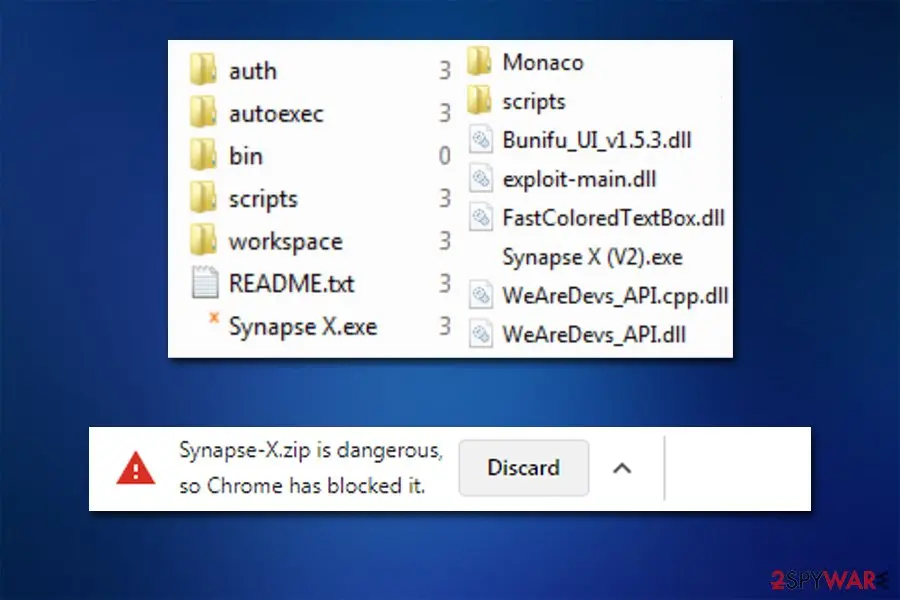
Synapse X.exe is the main executable of a scripting utility Synapse X and is not originally malicious.
However, users noticed that the process is consuming as much as 90% of the CPU/GPU usage while running in some cases, which usually indicates a digital currency mining malware Win32/CoinMiner. This process allows malicious actors to abuse victims' computer resources in order to transfer Bitcoin, Monero, or another cryptocurrency directly to cybercriminals' wallets.
Additionally, there have been indications that some versions of the Synapse X.exe are related to a Remote Access Trojan (RAT) called Orcus.
This malware can also be used for legitimate purposes, although has been sold on the underground forums as a malicious tool that would allow cybercriminals to steal various sensitive information, harvest crypto wallet data, take screenshots and perform various other remote activities that can cause significant harm to the infected individuals.
The file is also an executable that is often used for the distribution of the Discord malware variant Spidey Bot.
Due to these various traits of the process, users have been asking whether Synapse X is a virus or not. While each case is individual, we will try to explain to you what is Synapse X.exe and how to detect whether it is malicious.
Before trying to answer whether the version of Synapse X.exe running on your Task Manager is malicious, we should first explain the legitimate version. Synapse X, which runs the process in question in the background, itself is not malicious, as it is a scripting tool that was first released back in 2016.
As of 2020, the app was compatible with Windows 8 and later versions and helped users create scripts to automate processes that would otherwise be performed step-by-step.
Therefore, before you brand it a Synapse X.exe virus, you should check whether or not you installed the app intentionally via the official website hxxps://x.synapse.to/. Note that it is not free, and all the pirated versions might be infected with malware.
Additionally, many security applications might flag the app as malicious due to its nature, as scripting tools can be used for nefarious activities such as creating cheat scripts for video games.
If you have never installed the scripting tool itself, there is a high chance that the app is malicious, and Synapse X.exe removal should not be delayed. In most cases, threat actors can disguise malware executable under legitimate names, which makes users believe that the background process is not dangerous.
The main problem is that the legitimate Synapse X.exe can often be flagged as a false-positive by various anti-malware tools. However, if the app was downloaded from the official website, it should not pose any threats.
Thus, if you are after a legitimate Synapse X tool, navigate to the official website and downloaded the provided installer from there. Don't forget to set the much-needed exclusions within your security software and the web browser.
Cybercriminals use a variety of techniques in order to download and install the app behind users' backs, which include:
Once Synapse X virus gains access to Windows machines, it performs a variety of changes to them (in some cases, these modifications might not be reversed with anti-malware tool, so we suggest using for the purpose). In most cases, viruses import a variety of new files, initiate new processes, modify the Windows registry, etc.
The impact on the infected machine may vary depending on the type of malware that is disguised behind the Synapse X.exe file. For example, people who infect their machines with coin-mining malware should notice that the process uses a lot of CPU power (for example, 70% - 100%), and the system often crashes due to extreme loads.
In case the infection is related to Orcus RAT, barely any symptoms would be seen, and only reputable security software would detect the background activities. This is another reason to have powerful anti-malware installed on the system at all times - it can also stop the infection, so you won't have to remove Synapse X.exe Trojan and deal with its consequences.
The best way to uninstall Synapse X in case it is malware is by performing a full system scan with anti-virus software. In case the virus has blocked access to the security tool, you can access Safe Mode, as we explain below.
- Spam email attachments and embedded hyperlinks;
- Software vulnerabilities and exploits;
- Pirated program installers and software cracks;
- Boobytrapped ads;
- Weakly protected Remote Desktop (RDP) connections, etc.

From our report of Jun 2020 · not reviewed since
More from our earlier report on Synapse X.exe, Synapse X
- Various malware such as coinminers might cause significant damage to Windows systems, and they might struggle to run even after the infection is removed.
- Please check your anti-virus software.
How to check the PC for Synapse X.exe, Synapse X
- File:
X.exe
How to remove Synapse X.exe, Synapse X
How to remove Synapse X.exe, Synapse X and secure your accounts
A stealer usually takes what it wants within minutes and may already be gone.
The scan comes first, then the accounts.
Step 1: Scan the PC, then run the offline scan
A scan finds the parts of Synapse X.exe, Synapse X that the manual steps cannot see. In Windows Security > Virus & threat protection > Scan options, start a Full scan and quarantine what it reports.
Follow it with Microsoft Defender Antivirus (offline scan) > Scan now, which restarts the PC and checks the disk while Windows and the malware are not running.
It takes about 15 minutes and works the same in Windows 11 and Windows 10. If either scan finds something, run the full scan again after removal until it comes back clean.

Windows 11: Windows Security > Virus & threat protection > Scan options. Full procedure with screenshots: Run a Microsoft Defender Offline scan
Step 2: Change passwords from another device and sign out other sessions
Synapse X.exe, Synapse X can copy saved passwords, cookies and session tokens and send them out in seconds, so cleaning the PC does not undo the theft.
Change your passwords on a device that was never infected, starting with the e-mail account, since every other reset goes through it. On each account, end all other sessions and check the recovery e-mail, phone number and forwarding rules.
Then turn on two-step verification. Sign in on the Windows 11 or Windows 10 PC again only after the offline scan is clean.
Full procedure with screenshots: Turn on two-step verification / secure a hacked account
Step 3: Delete the folders left behind
Uninstalling often leaves the program's folders, and some threats reinstall themselves from them.
Press Windows + R, type
%LocalAppData%and press Enter, then do the same for%AppData%and %ProgramData%, and look for folders named after Synapse X.exe, Synapse X, its publisher or created on the day the problem started.Delete those folders, and check
C:\Program FilesandC:\Program Files (x86)too.If Windows says a file is in use, end it in Task Manager or delete the folder after a restart in Safe Mode. The folders are the same in Windows 11 and Windows 10.
Full procedure with screenshots: Remove what malware leaves behind in Windows
Instructions for each browser and system
The detailed steps for every browser and system this guide covers. Open the one you use.
Manual removal using Safe Mode
Important! →
Manual removal guide might be too complicated for regular computer users. It requires advanced IT knowledge to be performed correctly (if vital system files are removed or damaged, it might result in full Windows compromise), and it also might take hours to complete. Therefore, we highly advise using the automatic method provided above instead.
Step 1. Access Safe Mode with Networking
Manual malware removal should be best performed in the Safe Mode environment.
Windows 7 / Vista / XP
- Click Start > Shutdown > Restart > OK.
- When your computer becomes active, start pressing F8 button (if that does not work, try F2, F12, Del, etc. - it all depends on your motherboard model) multiple times until you see the Advanced Boot Options window.
- Select Safe Mode with Networking from the list.

Windows 10 / Windows 8
- Right-click on Start button and select Settings.

- Scroll down to pick Update & Security.

- On the left side of the window, pick Recovery.
- Now scroll down to find Advanced Startup section.
- Click Restart now.

- Select Troubleshoot.

- Go to Advanced options.

- Select Startup Settings.

- Press Restart.
- Now press 5 or click 5) Enable Safe Mode with Networking.

Step 2. Shut down suspicious processes
Windows Task Manager is a useful tool that shows all the processes running in the background. If malware is running a process, you need to shut it down:
- Press Ctrl + Shift + Esc on your keyboard to open Windows Task Manager.
- Click on More details.

- Scroll down to Background processes section, and look for anything suspicious.
- Right-click and select Open file location.

- Go back to the process, right-click and pick End Task.

- Delete the contents of the malicious folder.
Step 3. Check program Startup
- Press Ctrl + Shift + Esc on your keyboard to open Windows Task Manager.
- Go to Startup tab.
- Right-click on the suspicious program and pick Disable.

Step 4. Delete virus files
Malware-related files can be found in various places within your computer. Here are instructions that could help you find them:
- Type in Disk Cleanup in Windows search and press Enter.

- Select the drive you want to clean (C: is your main drive by default and is likely to be the one that has malicious files in).
- Scroll through the Files to delete list and select the following:
Temporary Internet Files
Downloads
Recycle Bin
Temporary files - Pick Clean up system files.

- You can also look for other malicious files hidden in the following folders (type these entries in Windows Search and press Enter):
%AppData%
%LocalAppData%
%ProgramData%
%WinDir%
After you are finished, reboot the PC in normal mode.
Choose a proper web browser and improve your safety with a VPN tool
Online spying has got momentum in recent years and people are getting more and more interested in how to protect their privacy online.
One of the basic means to add a layer of security - choose the most private and secure web browser. Although web browsers can't grant full privacy protection and security, some of them are much better at sandboxing, HTTPS upgrading, active content blocking, tracking blocking, phishing protection, and similar privacy-oriented features.
However, if you want true anonymity, we suggest you employ a powerful VPN - it can encrypt all the traffic that comes and goes out of your computer, preventing tracking completely.
Lost your files? Use data recovery software
While some files located on any computer are replaceable or useless, others can be extremely valuable.
Family photos, work documents, school projects - these are types of files that we don't want to lose. Unfortunately, there are many ways how unexpected data loss can occur:
- power cuts
- Blue Screen of Death errors
- hardware failures
- crypto-malware attack
- even accidental deletion
To ensure that all the files remain intact, you should prepare regular data backups. You can choose cloud-based or physical copies you could restore from later in case of a disaster. If your backups were lost as well or you never bothered to prepare any, can be your only hope to retrieve your invaluable files.
From our report of Jun 2020 · not reviewed since
Malware infection can be prevented with minimal effort
Computer security is often downplayed by regular users, as they claim that they can secure their machines from malware by just being careful.
While browsing the web attentively is a big part of general computer security, in many cases, users are unaware of how the infections can propagate. This can often result in various Trojan infections since victims are unaware that they are doing something wrong in the first place.
As previously mentioned, malware developers can use a variety of techniques to proliferate malicious programs on as many users devices as possible. These methods vary drastically when it comes to their sophistication and success, although in most cases, some type of social engineering is used.
The most common method of malware delivery is spam emails. Malspam campaigns are known to be one of the most successful tactics for regular consumers and even high-profile organizations or businesses. Therefore, you should never carelessly open email attachments or click on hyperlinks inside them, as they could immediately begin the infection routine. Additionally, there are several advanced security programs that constantly scan your inbox for potentially malicious files.
Additionally, security experts from lesvirus.fr advise following these security tips:
- Employ comprehensive security software and keep it updated;
- Download and install the latest Windows and application updates promptly;
- Enable additional protection - use firewall, ad-blockers, etc.;
- Do not download software cracks or pirated software installers;
- Use strong passwords for all your accounts;
- If using Remote Desktop, make sure it is adequately protected;
- Do not click on random links on social media and messaging apps.
From our report of Jun 2020 · not reviewed since
Synapse X.exe virus removal guide
Before you attempt Synapse X.exe removal, we highly advise you to check whether the tool is actually malicious.
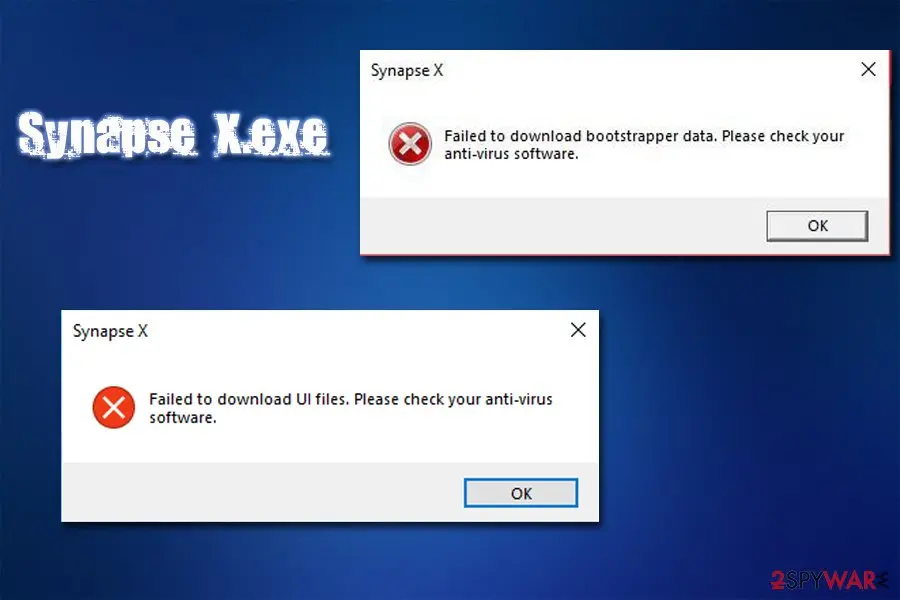
As mentioned above, it can often be detected by security software as malicious due to its operating principles. Additionally, you might receive the following message if that is the case:
In such a case, you should simply add the Synapse X file to exclusions on your anti-virus application, and you should be immediately able to run the app.
In case you never installed the utility yourself, you should remove Synapse X.exe Trojan from your computer as soon as possible. As it can represent a variety of different infections, we highly advise you use powerful anti-malware software for its termination, as manual removal can be extremely difficult, if not impossible, for regular computer users.
[GI=method-1]In case the virus does not allow your security program to run correctly, you can access Safe Mode with Networking and perform the scan from there:
Questions about Synapse X.exe, Synapse X
What is Synapse X.exe?
Synapse X.exe is a file that might relate to legitimate scripting software or malware infection. The main executable of legitimate scripting utility Synapse X is not originally malicious. However, malicious actors use the Synapse X name to disguise various malware types.
Users reported cases where the legitimate process consumed 90% CPU and GPU usage, indicating potential coin mining malware. Synapse X.exe versions also relate to Remote Access Trojan Orcus and Discord malware variant Spidey Bot. Each case requires individual assessment to determine if the file is legitimate or malicious.
Is legitimate Synapse X safe?
Yes, the legitimate Synapse X scripting tool itself is not malicious when downloaded from the official website x.synapse.to. It is a legitimate tool first released in 2016 compatible with Windows 8 and later. The application helps users create scripts to automate processes.
However, pirated versions are often infected with malware because Synapse X is not free software. Piracy sites commonly bundle malware with cracked software. Additionally, some anti-malware tools flag the legitimate version as suspicious due to its scripting nature, which can be misused for cheating or other purposes.
How can I tell if my Synapse X.exe is malicious?
Check if you intentionally installed Synapse X from the official website x.synapse.to. If you never installed it yourself, it is likely malicious. Monitor your Task Manager to see CPU usage percentages.
Legitimate Synapse X uses normal amounts of resources. High CPU usage like 70-100% indicates coin mining malware disguised as Synapse X. If your antivirus flags it, check whether it came from the official website. Malware detection of the legitimate version often means false positives, but malware versions consistently show suspicious behavior.
What malware disguises itself as Synapse X.exe?
Malware developers disguise various infections under the Synapse X name to exploit the tool's reputation. Orcus RAT (Remote Access Trojan) frequently masquerades as Synapse X.exe. CoinMiner variants use the name to hide while consuming CPU for cryptocurrency mining.
Discord malware variant Spidey Bot distributes through fake Synapse X executables. These fake versions cause financial losses through stolen cryptocurrency mining, data theft, file loss, and extreme performance degradation. Increased electricity bills from mining, random crashes, and reboots indicate malware infection.
How does malicious Synapse X.exe spread?
Malware using the Synapse X name spreads through various vectors including exploit kits, malvertising, and spam emails. Pirated software cracks and illegal installers frequently contain fake Synapse X versions.
Weakly protected Remote Desktop connections get compromised and infected with malware. Downloads from untrusted sources often include malicious versions. Torrent sites and crack repositories are prime distribution points.
The legitimate tool's popularity makes it an attractive cover for malware. Users searching for free versions or cracks expose themselves to infection.
Should I remove Synapse X.exe immediately if detected?
Only remove it if it is the malicious version. If you intentionally installed legitimate Synapse X from the official website and your antivirus flags it, mark it as safe and add exclusions rather than deleting it. However, if you never installed it yourself, removal should not be delayed.
Malicious versions require immediate removal. Never keep any Synapse X version if you are unsure of its origin or it shows suspicious behavior. When in doubt about legitimacy, prioritize removal over potentially keeping malware.
How do I remove malicious Synapse X.exe?
Download and install powerful security software and perform a full system scan. In Safe Mode with Networking, run the anti-malware scan to prevent the malware from blocking security tools. Various malware like coinminers cause significant damage to Windows systems, and they may fail to run even after removal.
Additional system repair tools help fix damage beyond malware elimination. If your security program blocks access to running correctly, Safe Mode access enables proper scanning. Complete system recovery may require multiple scans and repair steps.
How do I prevent fake Synapse X.exe infection?
Never download Synapse X from anywhere except the official website x.synapse.to. Avoid all pirated software, cracks, and keys from illegal sources. Do not use P2P services or torrent sites for software downloads.
Employ comprehensive security software and keep it updated. Download latest Windows updates promptly. Enable firewall and ad-blockers for additional protection.
Use strong passwords and protect Remote Desktop connections if enabled. Do not click random links on social media or messaging apps. If you need the legitimate tool, pay for it from the official source rather than seeking free versions.
Will Fortect remove Synapse X.exe, Synapse X?
Fortect scans Windows for malware and unwanted programs and repairs the system files and settings they change, and its free scan shows what it finds on your PC before you decide anything.
For Synapse X.exe, Synapse X, follow the plan above as well: the browser steps take back permissions and settings that no scanner treats as a threat, and uninstalling the program that brought it removes the source.
Run Microsoft Defender's full scan and, if anything was found, its offline scan as a second opinion. If the symptoms are gone after the plan and both scans are clean, there is nothing more to do.
Sources
- AnyRun: Synapse X.exe (read October 5, 2026)
- Tom's Guide: Discord 'Spidey Bot' Malware Is Stealing Usernames, Passwords (read October 5, 2026)
- Wikipedia: Exploit (computer security) (read October 5, 2026)
- Barracuda: Email – the #1 threat vector (read October 5, 2026)
- Lesvirus: Lesvirus (read October 5, 2026)