

Apple.com-faster.live – a scamming app that claims about a fake trojan virus detected on Mac
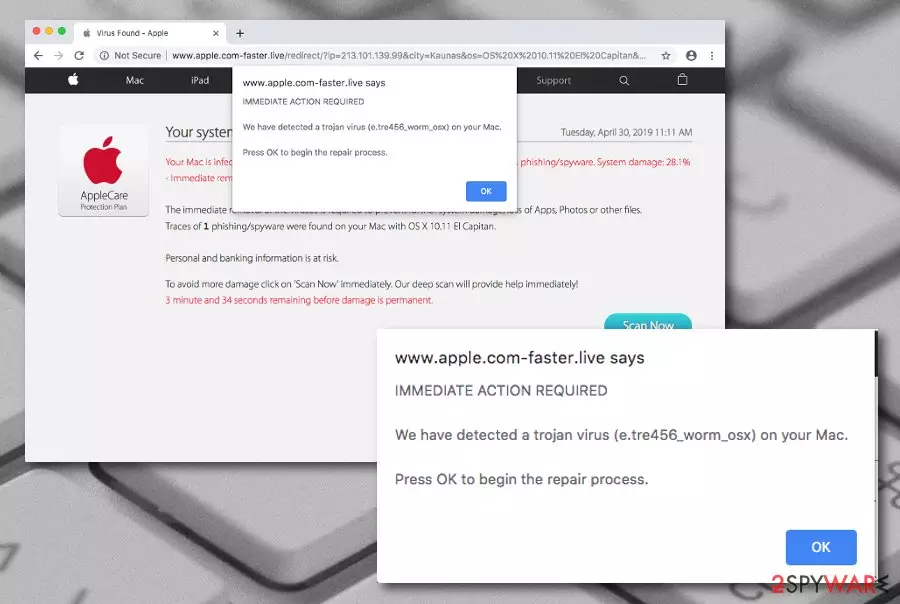
Apple.com-faster.live is a pop-up scam[1] that pushes fake information towards Mac users. This rogue message claims that it has detected three suspicious viruses on the infected computer system, one from which is the e.tre456_ worm_osx trojan virus.[2] Moreover, the misleading notification states that 28.1% of damage has already been caused to the machine and urges to click on the “Scan Now” button in five minutes for immediate help. This type of content is also known as scareware-related as it does not claim any true facts but only provides false data that can confuse and terrify users to take reckless actions. We strongly recommend preventing yourself from pushing the “Scan Now” button as it is only a scam and might trick you into installing completely worthless computer optimization software such as MacKeeper, Mac Mechanic, and similar tools.
Apple.com-faster.live pop-up scam is not the only one of this kind. These Mac-related scams are becoming very popular and attracting users' attention more and more frequently nowadays. For example, various adware-related programs or browser-hijacking apps support scamming applications such as Apple.com-fast.live, Apple.com-clear.live, Apple.com-optimize.live, Apple.com-speed-macos.live, and other similar ones.
| Name | Apple.com-faster.live |
|---|---|
| Program type | Scam |
| Targeted OS | Mac OS only |
| Similar apps | Apple.com-fast.live, Apple.com-clear.live, Apple.com-optimize.live, Apple.com-speed-macos.live |
| Fake trojan name | e.tre456_worm_osx |
| Disabling | Use adblocking tools such as Adblock to stop the appearance of the pop-up scam |
| The cause | In some cases, this scam message might be caused by adware |
| Appearance from | Installation can happen through other software |
| Removing | FortectIntego can scan the entire system and terminate the PUP within minutes |
There are many ways how Apple.com-faster.live pop-up might appear on your PC screen. In some cases, this type of content might not mean anything at all if you find it only on suspicious third-party pages. The scam can easily be removed by installing AdBlock. However, if the frequency of this pop-up's appearance starts increasing slightly, you should scan your system with a reputable system tool to check for possible adware traces.
If an ad-supported program is the one who is forcing you to deal with Apple.com-faster.live, you might start experiencing even more unpleasant activities. Adware applications are capable of causing redirects to secondary websites some of which might lack recommended protection and include potential threats. Moreover, advertising content will supposedly start bothering you and urging to purchase suspicious software or services.
Apple.com-faster.live virus claims about three dangerous viruses found on the system some of which are phishing or spyware-related. Additionally, the e.tre456_worm_osx trojan virus is presented as a harmful threat which needs to be removed immediately. The developers try to convince users to take sudden actions by this message:
www.apple.com-faster.live says
IMMEDIATE ACTION REQUIRED
We have detected a trojan virus (e.tre456_worm_osx) on your Mac.
Press OK to begin the repair process.
Apple.com-faster.live removal is necessary if it has been bothering you more than a couple of times. Probably adware is the cause and it needs to be terminated with all “helper components” included. To lengthen the process and complete it in an easy and safe way, you should install and run software such as FortectIntego. It is very important to ensure that all suspicious processes are canceled and eliminate, otherwise, the PUP might return within the next computer boot.
If you are likely to, you can remove Apple.com-faster.live by using the manual step-by-step guide that has been provided for you at the end of the article. There you will find simple but comprehensive instructing steps that will allow you to remove the adware application from your Mac operating system and also clean infected web browser apps such as Google Chrome, Mozilla Firefox, Internet Explorer, Microsoft Edge, Safari.

Adware-based content is secretly delivered by software bundles
It is not a secret that many third-party[3] developers bundle their apps together with original software. However, this might also be the way how adware gets into the user's system. Once he/she downloads free programs from the Internet, adware-based content might be together installed on the machine within a few clicks that have been not paid attention to.
According to experts from Virusai.lt,[4] there are some ways which will help you to prevent such secret installation of adware-related objects. First, if you are completing downloads on your own, you need to make sure that you put all concentration into the process and complete each step with big care. Missed downloading/installation steps might let adware into your computer.
Moreover, we always advise users to use ONLY original downloaders and avoid all other secondary ones. Once you are installing a particular application, you should always choose the Custom/Advanced configuration other the Quick/Recommended modes. In the Custom section, you will be able to reject incoming downloads that you do not want to perform.
Removal instructions for the Apple.com-faster.live pop-up scam message
Apple.com-faster.live removal can be completed without putting a lot of effort. If you are a less-experienced user in the threat elimination field, you should use reliable anti-malware software. These tools are capable of performing full system scans, detecting suspicious and damaging content, and eliminating it safely.
There are also some instructions provided below that should help you to remove Apple.com-faster.live virus manually. These guidelines have been created to guide users through the entire elimination process, help them bring their operating system and web browsers such as Chrome, Firefox, Edge, Safari, Explorer back to their previous states.
Delete from macOS
Remove the unwanted application:
- From the menu bar, select Go > Applications.
- In the Applications folder, look for any suspicious entries, then drag them to Trash (or right-click and pick Move to Trash).


Delete leftover files and folders:
- Select Go > Go to Folder.
- Enter /Library/Application Support and remove any suspicious folders related to the unwanted program.
- Repeat the same check in the /Library/LaunchAgents and /Library/LaunchDaemons folders, deleting any suspicious entries.

- Finally, empty the Trash to permanently remove the leftovers.

Reset Internet Explorer
Remove dangerous add-ons:
- Open Internet Explorer, click on the Gear icon (IE menu) on the top-right corner of the browser
- Pick Manage Add-ons.
- You will see a Manage Add-ons window. Here, look for suspicious plugins. Click on these entries and select Disable.


Change your homepage if it was altered:
- Open IE and click on the Gear icon.
- Select Internet Options.
- In the General tab, delete the Home page address and replace it by your preferred one (for example, Google.com).
- Click Apply and then select OK.


Delete temporary files:
- Press on the Gear icon and select Internet Options.
- Under Browsing history, click Delete...
- Select relevant fields and press Delete.


Reset Internet Explorer:
- Click on Gear icon > Internet options and select Advanced tab.
- Select Reset.
- In the new window, check Delete personal settings and select Reset.


Remove from Microsoft Edge
Delete unwanted extensions from MS Edge:
- Select Menu (three horizontal dots at the top-right of the browser window) and pick Extensions.
- From the list, pick the extension and click on the Gear icon.
- Click Remove.


Clear cookies and other browser data:
- Click on the Menu (three horizontal dots at the top-right of the browser window) and select Settings > Privacy, search, and services..
- Under Clear browsing data, pick Choose what to clear.
- Select Cookies and other site data and Cached images and files. (apart from passwords, although you might want to include Media licenses as well, if applicable) and click on Clear.


Restore new tab and homepage settings:
- Click the menu icon and choose Settings.
- Then find On startup section.
- Click Remove next to any suspicious startup page.
Reset MS Edge if the above steps did not work:
- Press on Ctrl + Shift + Esc to open Task Manager.
- Click on More details arrow at the bottom of the window.
- Select Details tab.
- Now scroll down and locate every entry with Microsoft Edge name in it. Right-click on each of them and select End Task to stop MS Edge from running.


Instructions for Chromium-based Edge
Delete extensions from MS Edge (Chromium):
- Open Edge and click select Settings > Extensions.
- Delete unwanted extensions by clicking Remove.


Clear cache and site data:
- Click on Menu and go to Settings.
- Select Privacy, search and services.
- Under Clear browsing data, pick Choose what to clear.
- Under Time range, pick All time.
- Select Clear now.


Reset Chromium-based MS Edge:
- Click on Menu and select Settings.
- On the left side, pick Reset settings.
- Select Restore settings to their default values.
- Confirm with Reset.
- This will disable extensions and reset startup pages but will not delete bookmarks, saved passwords, or browsing history.


Remove from Mozilla Firefox (FF)
Remove dangerous extensions:
- Open Mozilla Firefox browser and click on the Menu (three horizontal lines at the top-right of the window).
- Select Add-ons.
- In here, select the unwanted extension and click Remove.


Reset the homepage:
- Click three horizontal lines at the top right corner to open the menu.
- Choose Settings.
- Under Home, set your preferred homepage and new tab settings.
Clear cookies and site data:
- Click Menu and pick Settings.
- Go to Privacy & Security section.
- Scroll down to locate Cookies and Site Data.
- Click on Clear Data...
- Select Cookies and Site Data and Temporary cached files and pages, then click Clear.


Reset Mozilla Firefox
If clearing the browser as explained above did not help, reset Mozilla Firefox:
- Open Mozilla Firefox browser and click the Menu.
- Go to Help and then choose Troubleshooting Information.

- Under Give Firefox a tune up section, click on Refresh Firefox...
- Once the pop-up shows up, confirm the action by pressing on Refresh Firefox.



Remove from Google Chrome
Delete malicious extensions from Google Chrome:
- Open Google Chrome, click on the Menu (three vertical dots at the top-right corner) and select More tools > Extensions.
- In the newly opened window, you will see all the installed extensions. Uninstall all suspicious extensions related to the unwanted program by clicking Remove.


Clear cache and web data from Chrome:
- Click on Menu and pick Settings.
- Under Privacy and security, select Clear browsing data.
- Select Browsing history, Cookies and other site data, as well as Cached images and files.
- Click Clear data.


Change your homepage:
- Click menu and choose Settings.
- Look for a suspicious site in the On startup section.
- Click on Open a specific or set of pages and click on three dots to find the Remove option.
Reset Google Chrome:
If the previous methods did not help you, reset Google Chrome to eliminate all the unwanted components:
- Click on Menu and select Settings.
- In the Settings, scroll down and click Advanced.
- Scroll down and locate Reset and clean up section.
- Now click Restore settings to their original defaults.
- Confirm with Reset settings.


Delete from Safari
Remove dangerous extensions:
- Open Safari, click Safari in the menu at the top-left of the screen, and select Preferences.
- Go to the Extensions tab, look for any suspicious entries, and click Uninstall to remove them.


Clear history and website data:
- Click Safari in the menu and pick Clear History.
- Set Clear to all history and confirm with Clear History.


Reset Safari:
- Click Safari in the menu and select Preferences > Advanced.
- Enable Show Develop menu in menu bar.
- From the menu bar, click Develop and select Empty Caches.


Did this guide help?
Be the first to comment