
Viruses · 307 guides

Trojans removal guides, page 8 of 12

Hidden programs that give attackers remote access, and how to find and remove them.
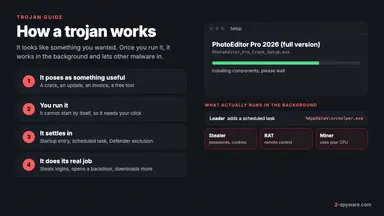
Start hereWhat is a trojan and how to remove itA trojan is malware disguised as something you wanted, such as a cracked program, a fake update or an invoice. It does nothing until you run it, then steals passwords, gives a stranger remote access or downloads more malware. To remove it, cut the startup entries it added, run a full and an offline scan, then change your passwords from a clean device.

Most searched trojans guides

  1. 1Remove Csrss.exe trojan
  2. 2Remove Memz virus
  3. 3Remove Wcupdater
  4. 4Remove Win32/Lodi
  5. 5Remove Chrome.7z
  6. 6Remove Iplogger.org

Trojans removal guides 190–216 of 307

Remove Valak malware

Valak malware is the hazardous trojan that launches processes on the targeted computer unnoticed Valak malware - is the so-called JavaScript loader because it uses JS to get on theTrojansHigh riskAlice Woods ·

Remove DanaBot

DanaBot trojan gathers sensitive information from the infiltrated system and includes ransomware-type virus features DanaBot - malware that spreads using spam email campaigns and malicious file attachments. Creators put malwareTrojansHigh riskLinas Kiguolis ·

Remove Zloader

Zloader is a threat that targets systems with the goal of obtaining banking information Zloader, otherwise known as Zeus Sphinx or Tredot, is banking malware that first emerged in AugustTrojansHigh riskLinas Kiguolis ·

Remove BlackMoon virus

BlackMoon banking Trojan steals people's banking information and delivers SkyStarts ransomware as a second payload BlackMoon is a reference to a trojan virus, which has been first spotted on theTrojansHigh riskUgnius Kiguolis ·

Remove CoreSync.exe

CoreSync.exe is the trojan that uses processes and files that run in the background triggering cryptojacking functionalities CoreSync.exe - malware that is designed to conceal cryptocurrency mining operations with executableTrojansHigh riskJake Doevan ·

Remove Dacls virus

Dacls is a dangerous Remote Access Trojan managed by Lazarus threat group that targets Windows, Linux, and Mac users Dacls virus is yet another dangerous Remote Access Trojan (RAT) pertainingTrojansHigh riskJulie Splinters ·

Remove Quasar virus

Quasar - a Remote Access Tool that has its legitimate and malicious uses Quasar virus is a Remote Access Trojan (RAT) that is often abused by cybercriminals to take remoteTrojansHigh riskJake Doevan ·

Remove Lucifer virus

Lucifer virus is the trojan that infects the machine and resides in the memory, so malware cannot be easily detected Lucifer virus – malware that is classified as a banking trojanTrojansHigh riskGabriel E. Hall ·

Remove EventBot

EventBot - dangerous financial malware designed for Android devices EventBot is a malicious application that can run on Android-based devices and targets users in the US and Europe. It wasTrojansHigh riskUgnius Kiguolis ·

Remove Cerberus virus

Cerberus virus is the memory-resident Android trojan that can fully control the device and steal financial data Cerberus virus – a threat that criminals use for accessing mobile phones and takingTrojansHigh riskJake Doevan ·

Remove Emotet

Emotet virus is a well-known banking trojan employed by numerous cybercriminal groups Emotet virus is one of the most prolific modular banking Trojans that first made an appearance back inTrojansHigh riskJake Doevan ·

Remove njRat

njRat is a multi-functional Remote Access Trojan that can log keystrokes and disable anti-malware software on the host machine njRat, also known as Bladabindi, is a Microsoft .NET framework-based Remote AccessTrojansHigh riskLucia Danes ·

Remove Lokibot virus

Lokibot is a Trojan malware that steals credentials, logs keystrokes, and can launch Jigsaw ransomware payload LokiBot is an info stealer Trojan malware[ref en-1] that can leak usernames, passwords, bankingTrojansHigh riskJake Doevan ·

Remove zlob.zipcodec

Zlob.zipcodec is a suspicious AV detection that may be a sign of a Trojan infection Zlob.zipcodec is a generic name that can be a false positive[ref en-1], software problem orTrojansHigh riskAlice Woods ·

Remove Guildma

Guildma - a dangerous banking Trojan that targets Latin American users Guildma is a sophisticated data-stealing malware that was recently discovered and analyzed by most prominent security research teams. TheTrojansHigh riskJake Doevan ·

Remove Ffshrine virus

Ffshrine virus - a dangerous Trojan related to a popular Final Fantasy Shrine Forum Ffshrine virus is a malicious Trojan horse[ref en-1] infection that might have been injected into FfshrineTrojansHigh riskJake Doevan ·

Remove AZORult virus

AZORult virus is the threat that gets used to spread other viruses to the target devices or gets added as a secondary payload AZORult Trojan is the cyber threat thatTrojansHigh riskLinas Kiguolis ·

Remove "The Requested Resource is in Use" error

"The Requested Resource is in Use" error - a dangerous Trojan virus that is capable of evading antivirus detection "The Requested Resource is in Use" error is a sign ofTrojansHigh riskLucia Danes ·

Remove Occamy.C

Trojan:Win32/Occamy.C is the malware that can open backdoors on the infected system for other hackers or load malware Trojan:Win32/Occamy.C is the malware that can be set to steal passwords or evenTrojansHigh riskJake Doevan ·

Remove Bitrep virus

Bitrep virus is the trojan horse infection that can be set to perform tons of different malicious processes on your device  Bitrep virus is the term used for a bigTrojansHigh riskLinas Kiguolis ·

Remove Kronos malware

Kronos malware is the trojan designed to steal sensitive information from victims and transfer funds from the bank accounts Kronos malware – banking trojan that had a few updates since 2014TrojansHigh riskAlice Woods ·

Remove Trojan.Agent

Trojan.Agent is a generic definition of particular malware that can be set to do a variety of malicious tasks on the infected machine Trojan.Agent is a heuristic[ref en-1] detection nameTrojansHigh riskUgnius Kiguolis ·

Remove NanoCore virus

NanoCore virus is a dangerous trojan that uses spam email campaigns to spread around NanoCore virus is a backdoor and a remote access trojan that is used in a varietyTrojansHigh riskOlivia Morelli ·

Remove Kwampirs malware

Kwampirs malware is a backdoor Trojan that targets healthcare organizations and infects computers connected to medical equipment Kwampirs is malware with worm-like capabilities mainly used by a hacking group likeTrojansHigh riskLinas Kiguolis ·

Remove Regin virus

Regin malware is a Trojan developed by National Security Agency to gather intelligence information on targeted Windows machines Regin virus is a multi-stage malware program designed to open a backdoor[refBackdoorsHigh riskLinas Kiguolis ·

Remove Win32:Evo-gen

Win32:Evo-gen – is the threat indicator that can be triggered on Windows devices  Win32:Evo-gen is a heuristic detection name used by anti-malware tools on Windows OS devices - it shows upTrojansHigh riskOlivia Morelli ·

Remove Support Greta Thunberg spam

Support Greta Thunberg email scam is the campaign used to spread Emotet Trojan and other malware Support Greta Thunberg spam - is the email virus that is designed to monetizeSPAM toolsLow riskJulie Splinters ·
5,558 members already hereReading, writing, commenting and voting. 0 verified · 283 joined this year